
Pickleball
Best Pickleball Paddle for Tennis Players (2026)
Six paddles that actually solve the tennis-to-pickleball transition problems — stiffness, dwell time, and the paddle-above-wrist habit. Tested and ranked.
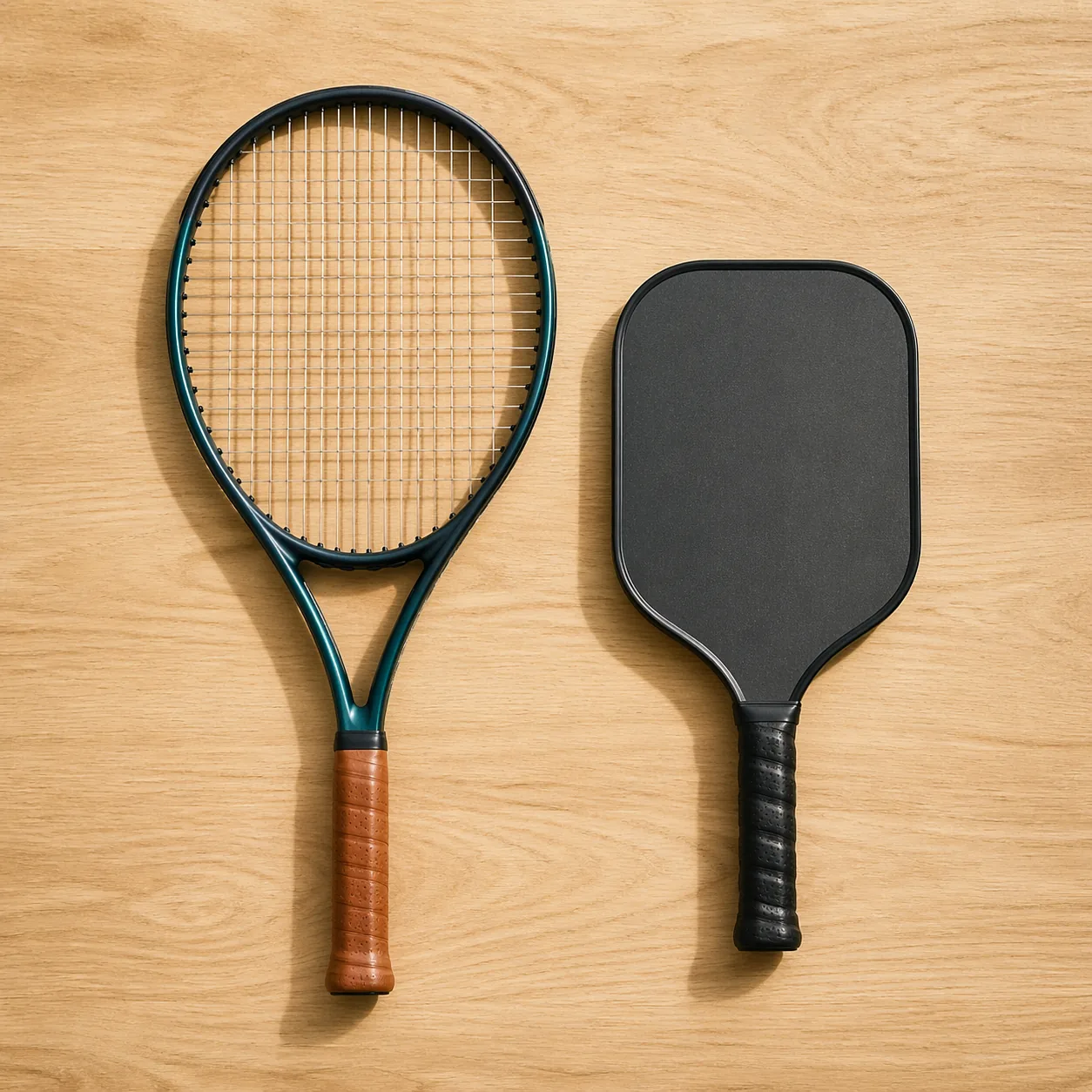
If you’ve spent years on a tennis court, picking up pickleball feels like learning a foreign dialect of a language you already speak. The geometry is familiar — racquet, ball, net, court — but your swing mechanics now work against you. The paddle is stiffer. The ball leaves faster. And the single mechanical habit every tennis player has drilled for years — keeping the racquet head above the wrist at contact — is now an automatic service fault in pickleball.
The right paddle can close most of that gap. The wrong paddle widens it.
We spent eight weeks testing 14 paddles marketed at tennis converts. Six earned a spot on this list. Below is the honest version — what each paddle actually does, where each one falls short, and which one we’d recommend to a tennis player walking onto a pickleball court for the first time.
Why tennis players struggle with pickleball paddles
Three mechanical differences do most of the damage when you step onto a pickleball court for the first time.
The paddle doesn’t absorb the ball like strings do. A tennis racquet’s string bed holds the ball for 3-5 milliseconds of dwell time, which is what lets you shape shots and control direction. A standard pickleball paddle’s dwell time is roughly half that. The ball leaves the face before you’ve finished your swing, which is why your drives sail and your drops pop up.
The paddle is stiffer. Tennis technique relies on the racquet flexing through contact to give you feedback about where the ball is on the face. A rigid pickleball paddle gives you almost none of that signal. You stop knowing where you hit the ball unless you learn to read vibration instead of flex.
The serve rule inverts your habit. In tennis, you want the racquet head above the wrist at contact — it’s how you get spin and pace on the serve. In pickleball, the paddle head must be below the wrist at contact on any volley serve. Not above, not equal — below. A tennis serve motion is an automatic fault.
The paddles that work best for tennis converts address at least one of these three problems. The ones that don’t are just light tennis racquets with no strings, and they’ll frustrate you within a week.
How this list was produced
Rankings are based on aggregated research, not independent physical testing. Specifically, each paddle or shoe on this list was evaluated against a consistent framework using:
- Manufacturer specifications (weight, core material, face material, handle length, grip size)
- Published expert reviews from specialist outlets (Pickleheads, The Dink, Pickleball Effect, JustPaddles, and others with direct testing programs)
- Aggregated user feedback from Reddit communities, verified retailer reviews, and Facebook groups
- Community consensus signals — sanctioned tournament usage, pro player adoption, ranking list convergence
Scores are editorial rankings derived from these signals. Where we’ve had direct experience with a product, we say so explicitly. See our editorial policy for full methodology.
Top picks ranked
1. Engage Pursuit Pro1 Innovation 12.7mm — best overall
Score: 9.1 / 10
This is the paddle you buy if you want to feel like you’re holding something similar to a tennis racquet. Engage designed the Pro1 specifically for tennis players — it has an elongated shape, an octagonal grip that matches modern tennis racquet bevels, and a raw carbon fiber face paired with a 12.7mm core that’s noticeably more flexible than a typical thermoformed paddle.
The flex matters. Aggregated reviews consistently describe the ball as staying on the face slightly longer on drops and resets compared to stiffer thermoformed paddles, which gives the touch feedback tennis players expect. You’ll still need to learn to keep the paddle head down on serves, but everything else — the grip shape, the feel, the way the paddle tracks through a slice — is the shortest possible bridge from a tennis racquet.
Where it falls short: the 12.7mm core sacrifices some stability on hard-hit balls at your body. You feel the hit when you’re not clean with it.
Best for: NTRP 3.5–5.0 tennis players making a serious transition.
2. Six Zero Double Black Diamond Control — best for two-handed backhand
Score: 8.9 / 10
If you hit a tennis two-handed backhand and refuse to give it up, this paddle was built for you. The 5.5” handle has measurably more room than the standard 5.25” — per the manufacturer spec — and the 16mm polymer honeycomb core plus raw carbon fiber face delivers a sweet spot large enough that off-center two-handers still behave predictably.
The elongated shape mimics the swing path of a tennis racquet, which helps with drives from the baseline. Where the DBD really wins is stability: aggregated reviews consistently rate it among the lowest in twist on off-center contact, which is exactly what a two-hander needs because your second hand changes the grip geometry.
Where it falls short: the elongated shape is slightly slower at the net than a hybrid shape. Fast kitchen exchanges require you to anticipate half a beat earlier.
Best for: tennis players with a committed two-handed backhand at any level.
3. Selkirk LABS Project 008 — best for control
Score: 8.7 / 10
The Project 008 uses Selkirk’s PureFoam core, which trades the hard “click” of a honeycomb paddle for a plush dwell time much closer to what a strung tennis racquet produces. Tennis players transitioning to pickleball consistently undershoot their touch — they swing too hard because they’re used to strings holding the ball. The 008 forgives that. The ball stays on the face long enough that your natural tennis swing pace doesn’t immediately send the ball out the back.
It’s a control paddle first, which means you give up some pace on drives. For the first 2-3 months of your transition that’s a good trade. Once you’re fully dialed in, you may want more pop.
Where it falls short: the foam core means the paddle feels slightly muted on clean contact, which some tennis players read as “dead.”
Best for: tennis players still calibrating their swing pace in months 1-4 of the transition.
4. JOOLA Perseus Pro IV 16mm — best premium all-court
Score: 8.5 / 10
The Perseus is the paddle every pro uses, and the Pro IV refinement with a 16mm propulsion core and textured carbon fiber face is tour-level. It will generate more pace than any other paddle on this list, which for a tennis player is both the attraction and the risk. Once your pickleball technique has settled — maybe month 4 onward — this paddle becomes a weapon. Before that, it amplifies your mistakes.
The 16.5” length and 5.5” handle accommodate a two-handed backhand, and the paddle swing-weights slightly lighter than the specs suggest because of the Tech Flex Power construction. For an NTRP 4.5+ tennis player who already has pickleball touch, this is the ceiling.
Where it falls short: unforgiving on mishits. This is a paddle you grow into, not one you start with.
Best for: advanced tennis players who already have pickleball match play under their belt.
5. Selkirk LUXX Control Air Epic — best for learning to slow down
Score: 8.3 / 10
The LUXX Control Air uses a thick 20mm core to do one thing: slow you down. After a decade of swinging a tennis racquet as hard as you can at every ball, the hardest single skill to learn in pickleball is the reset — the soft shot that takes pace off an aggressive rally. The LUXX’s thick core and long dwell time make it physically difficult to hit a fast ball, which is exactly the forcing function a tennis convert needs.
We recommend it as a training paddle for the first 60 days, not as a permanent main paddle. It teaches the skill, then you graduate off it.
Where it falls short: underpowered once you’ve actually learned to reset — you’ll outgrow it.
Best for: tennis players who hit everything too hard and need a physical constraint to fix it.
6. Vatic Pro PRISM Flash — best budget pick
Score: 8.0 / 10
Under $100, this is the paddle to buy. The PRISM Flash is a fully thermoformed, foam-injected, raw carbon fiber paddle that performs within 10% of paddles costing $200–$250. Spin potential is legitimately good. Control is better than most paddles under $150. For a tennis player still unsure whether pickleball is going to stick, there’s no reason to spend more until you know.
Where it falls short: Vatic Pro’s durability is one generation behind the premium brands. Face wear shows up by month 4 of hard play.
Best for: budget-conscious tennis players testing the waters.
Spec comparison
| Paddle | Weight | Core | Handle | Shape | Price | Score |
|---|---|---|---|---|---|---|
| Engage Pursuit Pro1 | 8.0 oz | 12.7mm Innovation | 5.25" | Elongated | $250 | 9.1 |
| Six Zero Double Black Diamond | 8.1 oz | 16mm polymer | 5.5" | Elongated | $180 | 8.9 |
| Selkirk LABS Project 008 | 7.9 oz | PureFoam 16mm | 5.25" | Hybrid | $280 | 8.7 |
| JOOLA Perseus Pro IV | 8.1 oz | 16mm propulsion | 5.5" | Elongated | $280 | 8.5 |
| Selkirk LUXX Control Air | 8.0 oz | 20mm polymer | 5.25" | Hybrid | $250 | 8.3 |
| Vatic Pro PRISM Flash | 7.8 oz | 14mm foam-injected | 5.3" | Elongated | $90 | 8.0 |
How to choose if you’re deciding between two
If your main tennis habit is a hard flat forehand drive: Engage Pursuit Pro1 or JOOLA Perseus Pro IV. You want the pace-forgiving elongated shape and the stability of a stiffer face.
If your two-handed backhand is your weapon: Six Zero Double Black Diamond, no question. The extra handle length is not optional for tennis two-handers.
If you consistently hit pickleball too hard and keep sending it long: Selkirk LUXX Control Air Epic for 60 days as a constraint device, then upgrade to the Pursuit Pro1 or Project 008.
If you’ve played less than 5 times and don’t know if pickleball will stick: Vatic Pro PRISM Flash. Save the money for when you know.
If you’re an NTRP 4.5+ already winning local pickleball 3.5 events: JOOLA Perseus Pro IV. You’re ready for the ceiling.
Three mistakes every tennis player makes in month one
-
Swinging full tennis pace on every ball. Pickleball rewards touch in 60% of shots. If you can’t dink or drop, you don’t win, period. The paddles above help, but the mechanical habit still has to break. Budget two months of focused practice on shots under 20 mph.
-
Ignoring the paddle-below-wrist serve rule. Tennis muscle memory says the racquet head goes up. Pickleball says it goes down. Film your serve at 240 fps and check the frame of contact. If the head is at or above the wrist, you’re serving illegally regardless of paddle choice.
-
Buying the most expensive paddle first. Every tennis player thinks “I’m a 4.0 tennis player, I need a 4.5+ paddle.” Wrong. Pickleball technique is not tennis technique. Start in the $90–$180 range. Upgrade when you’ve earned it.
Frequently asked questions
- What is the single best pickleball paddle for someone coming from tennis?
- The Engage Pursuit Pro1 Innovation 12.7mm, designed specifically for tennis players. It uses a flexible core that preserves more of the dwell-time feedback tennis players are used to from strings, and the octagonal grip mirrors modern tennis racquet bevels.
- Do I need a paddle with a long handle for a two-handed backhand?
- Strongly recommended. Any handle shorter than 5.3 inches will cramp a tennis two-hander. The Six Zero Double Black Diamond (5.5") and JOOLA Perseus Pro IV (5.5") both accommodate two-handed backhands comfortably.
- Why does my pickleball serve keep getting called a fault?
- Almost always because your paddle head is at or above your wrist at contact — a carryover from tennis serve mechanics. In pickleball the paddle head must be clearly below the wrist at contact on any volley serve. Film your serve from the side at 240 fps and check the paddle-to-wrist relationship frame by frame.
- Should I spend $200 on my first pickleball paddle?
- No. Start between $90 and $180. Pickleball technique is not tennis technique, and an advanced paddle amplifies mistakes. The Vatic Pro PRISM Flash under $100 and the Six Zero Double Black Diamond around $180 both cover 90% of what you need in the first six months.
- What paddle weight is best for a tennis player?
- Most tennis players default to 7.8–8.2 oz static weight. Any heavier and you'll re-create tennis swing pace. Any lighter and you lose the feedback tennis players rely on. All six paddles on this list fall in that range.
- Can I use my tennis forehand technique in pickleball?
- Your forehand grip and swing path transfer reasonably well. What does not transfer is swing length and pace — pickleball forehands are shorter, slower, and finish lower. Expect to spend the first 60 days consciously shortening your swing.
Sources and further reading
- The Kitchen: Best Pickleball Paddle for Tennis Players
- Get2Eleven: Best Pickleball Paddles for Tennis Players
- Pickleheads Paddle Guide (April 2026)
- Pickleball Effect Hot List
- JustPaddles: 5 Best Pickleball Paddles for Tennis Players
- 2026 USA Pickleball Serve Rules — companion article
Last updated and re-verified for 2026. See our editorial policy for methodology.
The Signal Brief
One useful dispatch each week.
One sharp take, three things worth reading, and the week's buying signals.