
Pickleball
Indoor vs Outdoor Pickleballs: What's Actually Different
Indoor and outdoor pickleballs are not interchangeable. Hole count, weight, plastic hardness, and wind resistance all change. Here's the honest comparison.
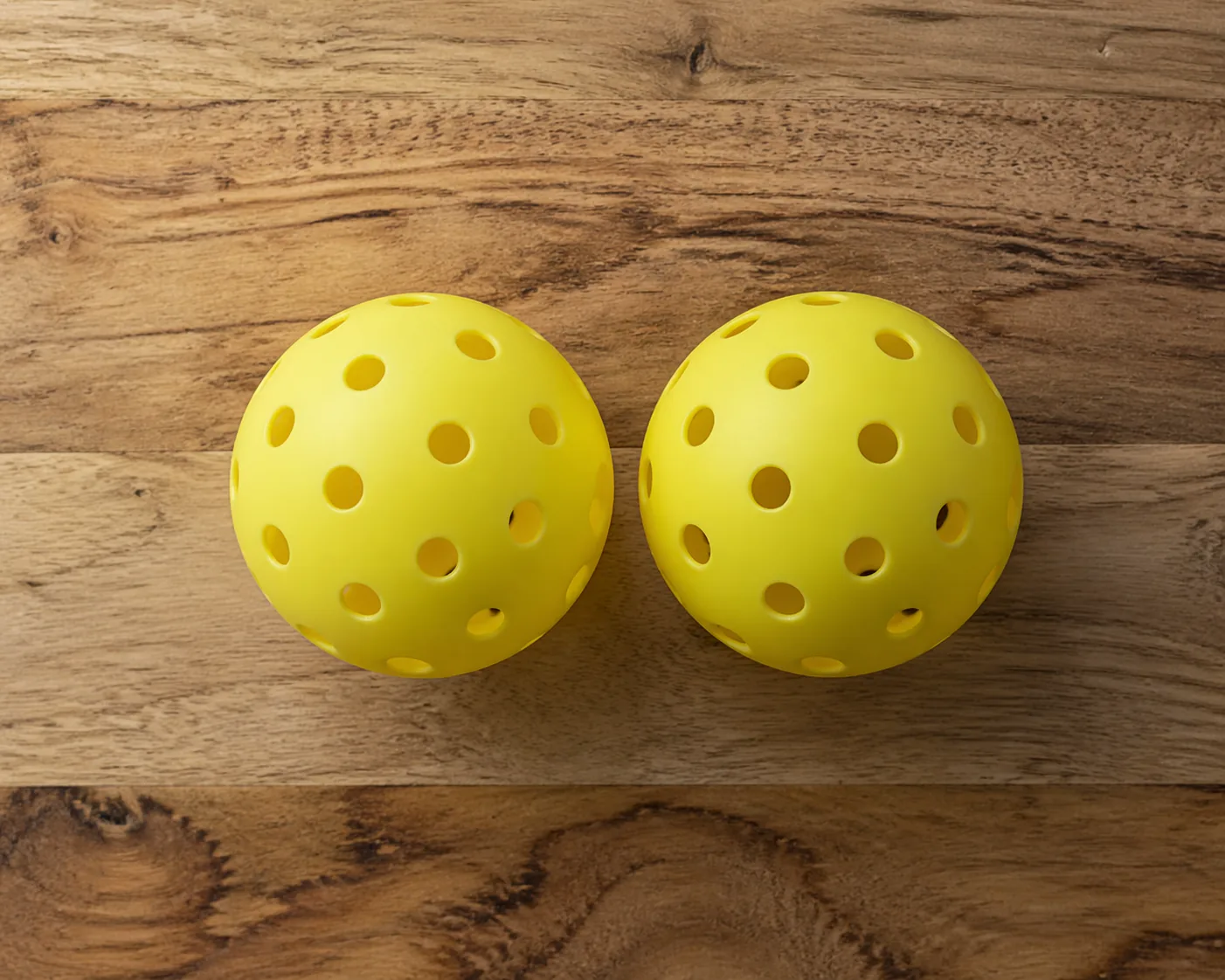
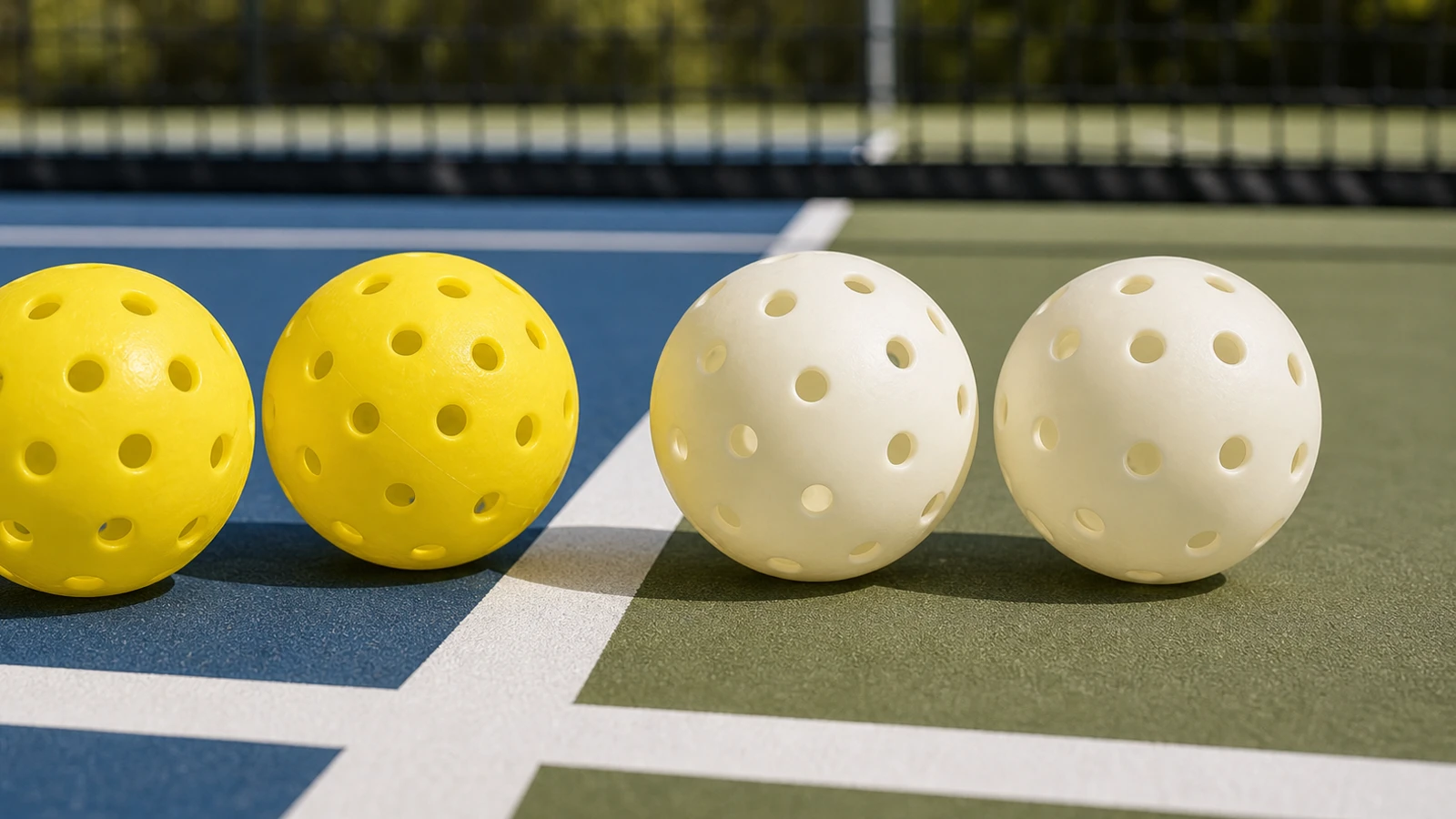
Indoor and outdoor pickleballs look similar and weigh almost the same. They’re not interchangeable. Using an outdoor ball indoors makes the game feel frantic and ball-chase-y; using an indoor ball outdoors turns every gust of wind into a point-deciding variable. The specifics of each ball type are deliberate, and knowing why they differ helps you pick the right ball and — if you want — understand why your rec dink drill yesterday felt completely different from the one the week before.
The actual differences
Hole count
Indoor pickleballs have 26 holes. Outdoor pickleballs have 40 holes.
The larger number of smaller holes on outdoor balls isn’t arbitrary — smaller holes reduce wind resistance. A 26-hole indoor ball hit outdoors in any kind of breeze will curve, slow, and behave unpredictably. A 40-hole outdoor ball hit indoors flies through the air too fast for the stopping distance most gym courts allow.
Plastic hardness
Outdoor balls are made of harder plastic compound. This matters for two reasons:
Durability. Outdoor courts are rough concrete or asphalt. Softer indoor plastic would crack or deform in a few sessions. Harder plastic shrugs off the abrasion.
Bounce. The harder plastic of outdoor balls produces a higher, more consistent bounce off concrete — a softer ball would absorb into the surface unevenly. Indoors, the reverse: harder plastic on a wood floor gives an excessive bounce, so the softer indoor ball gives you a more predictable response.
Weight
Outdoor balls weigh approximately 0.92 oz (26 g). Indoor balls weigh approximately 0.88 oz (25 g). The difference is small but noticeable — outdoor balls feel slightly weightier on impact and travel slightly farther on equivalent paddle swings.
Speed
Outdoor balls move noticeably faster. The combination of smaller holes (less air drag), harder plastic (more elastic rebound), and slightly heavier mass makes rallies 15–20% faster on average. If you’ve only played indoors and step onto an outdoor court for the first time, you’ll feel behind the ball for the first game or two. That’s normal.
Bounce pattern
On their respective surfaces:
- Indoor ball on wood: consistent, slightly soft bounce that allows for finesse at the kitchen.
- Outdoor ball on concrete: high, lively bounce that rewards power and penalizes passive hands.
Swap them:
- Indoor ball on concrete: too soft, deforms on each bounce, unpredictable.
- Outdoor ball on wood: too lively, bounces excessively, the game becomes unplayable for kitchen-focused rallies.
Which outdoor ball to buy
The outdoor ball market is dominated by two options that are used in most tournaments: Franklin X-40 and Dura Fast 40. We’ve tested both extensively.
Franklin X-40 — best all-around outdoor
The X-40 is officially the USA Pickleball tournament ball and the most commonly used outdoor ball in the US. It’s slightly softer than the Dura Fast 40, which some players interpret as “more forgiving” and others as “less crisp.” Durability is good — typically 4–6 hours of play before the ball loses roundness.
Best for: tournament players, most rec play, players who prefer a slightly softer feel.
Dura Fast 40 — best for durability
The Dura Fast 40 is the longer-lived ball. It’s slightly harder, which makes it feel snappier off the paddle and slightly more wind-resistant. Pros often prefer it for its consistency. Typical life is 6–10 hours before visible cracking.
Best for: players who want the ball to last, windy conditions, players who prefer a snappier feel.
Other outdoor options
- Onix Fuse G2: A sanctioned alternative, slightly different flight characteristics. Lower popularity but not a bad ball.
- Selkirk Pro S1: Selkirk’s tournament ball, more recently released. Plays well; less field-tested than X-40 and Dura Fast.
Which indoor ball to buy
Indoor ball choice is less competitive — there are fewer widely-used options, and they mostly play similarly.
Onix Fuse Indoor — most commonly used
The default indoor tournament ball in the US. 26 holes, correct weight, good bounce on wood floors. You’ll see it most often in indoor rec and tournament play.
Jugs Indoor — budget-friendly
The Jugs is cheaper and widely available. Plays similarly to the Onix Fuse indoor for most rec purposes. Less commonly used in tournaments but fine for weekly rec play.
When to retire a ball
All pickleball balls lose roundness as they’re played. You’ll notice:
- The ball wobbles in flight (loss of balance from uneven wear)
- Cracks appear in the plastic (late-stage; replace immediately)
- Bounce becomes inconsistent from shot to shot
- The ball has a visible dent or flat spot that doesn’t reform
Outdoor balls generally last 4–10 hours of play. Indoor balls last longer in calendar time because the wood-floor impact is gentler, but cracks develop eventually.
Tournament rule of thumb: a ball used for more than 2 games of tournament play is typically retired, even if it still looks fine. For rec play, squeezing every last hour is fine.
Ball specs quick reference
| Spec | Indoor | Outdoor |
|---|---|---|
| Hole count | 26 | 40 |
| Hole size | Larger | Smaller |
| Plastic | Softer | Harder |
| Weight | ~0.88 oz (25 g) | ~0.92 oz (26 g) |
| Speed | Slower | Faster |
| Surface | Smooth gym floors | Rough concrete/asphalt |
| Life per ball | 10+ hours | 4–10 hours |
| Dominant brands | Onix Fuse, Jugs | Franklin X-40, Dura Fast 40 |
Outdoor ball performance in different weather
| Condition | Impact |
|---|---|
| Cold (under 50°F) | Plastic stiffens; ball feels hard and crack-prone. Balls break faster. |
| Hot (over 95°F) | Plastic softens; ball feels mushy, less lively. Many players carry spares. |
| Windy | Flight path changes dramatically; outdoor balls are designed to minimize this but can’t eliminate it. Short of calm conditions, expect some unpredictability. |
| Wet surface | Most outdoor courts are unplayable when wet — not a ball issue, a safety issue. |
If you’re choosing balls for a home or backyard court, solve the court budget first. The Court Cost Calculator gives a quick estimate for surface, net, lighting, fencing, and labor before smaller gear decisions take over.
Frequently asked questions
- Can I use an outdoor pickleball indoors?
- You can physically, but the game won't play well. The outdoor ball is too fast and bouncy on indoor surfaces — rallies become chaotic, and kitchen-line play becomes nearly impossible to control. Also, the hard plastic can damage wood gym floors on aggressive hits. Most gyms ask you not to use outdoor balls inside.
- Can I use an indoor pickleball outdoors?
- It'll play poorly — the 26-hole indoor ball gets pushed around by wind, doesn't bounce consistently on concrete, and will crack within a few hours on rough surfaces. Not recommended.
- What's the best outdoor pickleball for beginners?
- The Franklin X-40. It's softer and slightly more forgiving than the Dura Fast 40, it's the standard used at most rec facilities, and it's widely available. Start here; try the Dura Fast 40 once you've played enough to have a preference.
- How many pickleballs should I buy at once?
- At minimum, buy a 3-pack. One ball breaks or goes out of bounds during a session more often than you'd think. For regular rec players, a 12-pack bulk pack of Franklin X-40 is the best value — you'll cycle through them over 2–3 months of play.
- Are there pickleballs that work well for both indoor and outdoor?
- No. The physics problem is real — any ball that handles wind and concrete durability (outdoor requirements) will be too fast for smooth indoor surfaces. Manufacturers have tried 'hybrid' or 'universal' balls; none perform well on either surface. Buy one of each.
- Do pickleball balls break differently in cold weather?
- Yes. Cold stiffens the plastic and makes it brittle. Outdoor pickleballs played in temperatures below 50°F tend to crack in 2–3 hours instead of 6+. Many serious outdoor players bring a small warmer or keep spare balls in a car trunk that's out of direct cold.
Sources and further reading
- Pickleball Science: Dura Fast 40 vs Franklin X-40
- The Dink: Complete Pickleball Ball Buying Guide
- Pickleball Union: Franklin X-40 & X-26 Review
- The Kitchen: Best Pickleballs for Every Purpose
- Joys of Pickleball: 19 Brands Tested
- Related: Best Indoor Pickleball Shoes · Best Outdoor Pickleball Shoes · Court Cost Calculator
Last updated April 29, 2026.
The Signal Brief
One useful dispatch each week.
One sharp take, three things worth reading, and the week's buying signals.