
Pickleball
The 20-Minute Pickleball Wall Drill Routine That Works
Four wall drills, 5 minutes each, done three times a week. Measurably improves dinks, volleys, resets, and groundstrokes in 4–6 weeks.
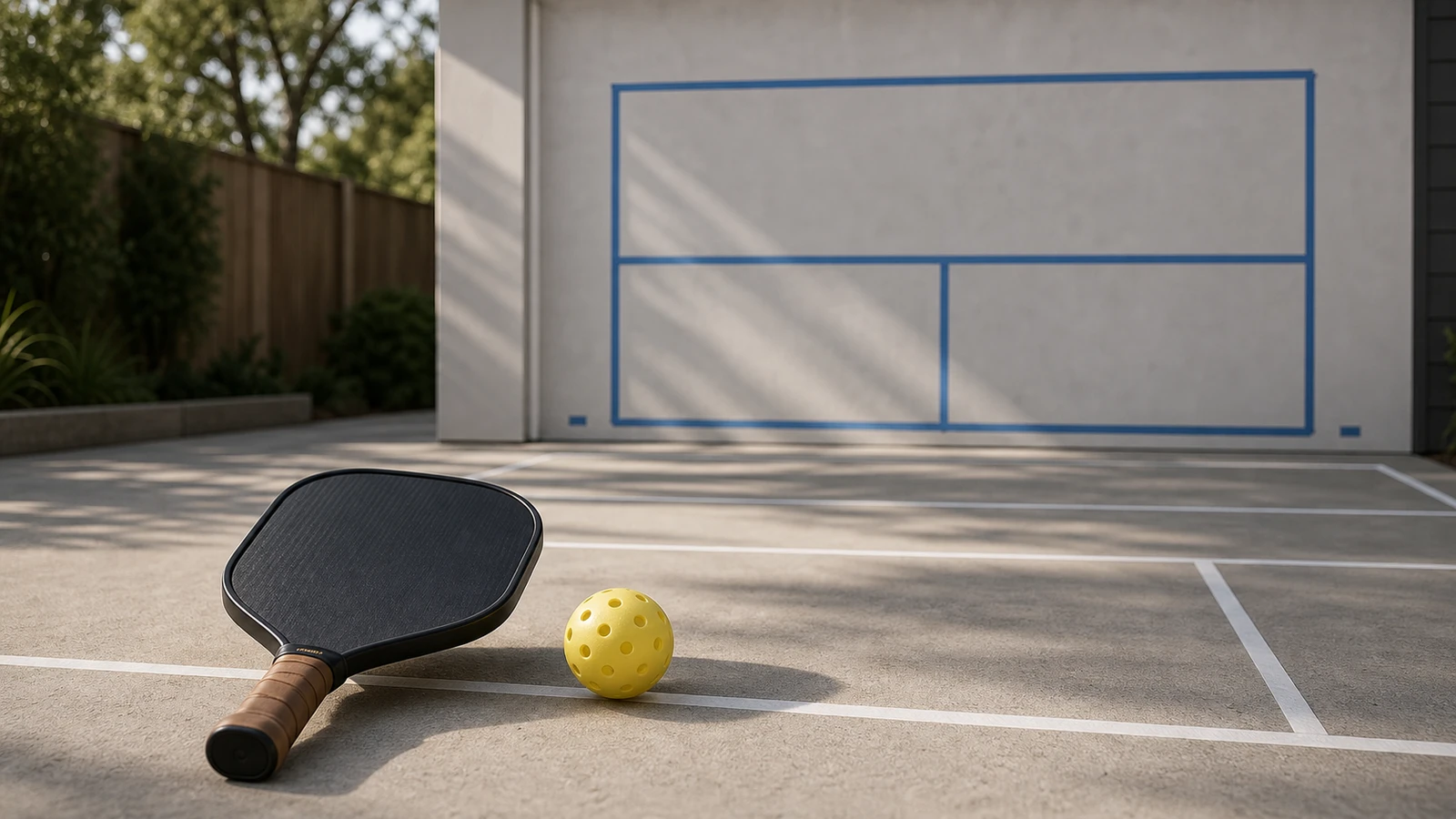
Wall drills are the most underused practice tool in recreational pickleball. Twenty minutes on a wall produces 400–600 shots versus ~200 shots in the same time of rec doubles. The repetition density is what drives improvement.
Below is a four-part routine, 5 minutes each, that targets the skills most likely to raise your DUPR. Done three times per week, you’ll see measurable improvement in 4–6 weeks.
Why walls work
Wall drills produce three benefits real rec play doesn’t:
Rep density. You hit 400–600 shots in 20 focused minutes. A rec doubles session produces 150–200 shots in the same time — the rest is chasing balls, taking breaks, and conversation.
Consistent feed. The wall returns the ball at a predictable angle and speed based on how you hit it. This consistency is what allows muscle memory to form.
Compressed reaction time. The wall is closer than an opponent, so you have less time between shots. This forces faster hand skills and quicker paddle positioning.
Sports science research on motor learning consistently finds blocked repetition (same shot, same conditions, many times) to be the fastest way to build new movement patterns. Walls deliver this better than any other practice format.
Setup requirements
You need:
- A flat wall at least 8 feet wide and 10 feet tall. Garage door works. Outdoor brick wall works. Indoor racquetball court works best.
- 10+ feet of clear space in front of the wall.
- Mark a net line using tape or chalk at 34 inches (the pickleball net’s low point). This gives you a visual target for dink drills.
- A paddle and 2–3 outdoor pickleballs (Franklin X-40 or Dura Fast 40).
The routine
Each drill: 5 minutes. No breaks between drills. Total: 20 minutes.
Minute 0–5: Dink Consistency
Setup: Stand 6–7 feet from the wall. Target the wall at the net-line height (34 inches from the floor).
Drill: Dink the ball into the wall at the marked line. Aim for the ball to return to you at hip height or lower. Focus on:
- Paddle face slightly open
- Relaxed grip (3/10 tension)
- Quiet wrist — no flicking
Count your longest streak. Goal: 30 consecutive dinks without miss.
Progression: Once you consistently hit 30+, add lateral movement — alternate forehand and backhand dinks while sidestepping left-right.
Minute 5–10: Volley Reaction
Setup: Stand 4–5 feet from the wall. Target mid-wall, chest height.
Drill: Quick punchy volleys. The ball returns fast because you’re close. Keep your paddle up. Minimize backswing — this is a wrist-free punch, not a swing.
Goal: 50 consecutive volleys without the ball dropping below waist height.
Focus cues:
- Paddle up at chest in between shots
- Use hips and shoulders to direct the ball, not the wrist
- Step forward into the ball, not backward
Minute 10–15: Reset / Block
Setup: Stand 8–9 feet from the wall. Hit a hard drive first to start the rally fast, then shift mindset to absorbing and placing.
Drill: Take the fast ball from the wall and “reset” it — redirect softly so it lands near the wall at the net-line height, taking all pace off.
Focus cues:
- Absorb the ball with a soft paddle hand (grip drops to 2/10)
- Short backswing, short follow-through
- Open face slightly to lift the ball into its soft arc
Goal: After 20 reps, you should be able to redirect 70% of fast balls into the low-pace zone at the wall.
Minute 15–20: Groundstroke Progression
Setup: Stand 12–15 feet from the wall (as far as your space allows).
Drill: Full groundstroke rallies — forehand and backhand. Alternate driving the ball into the wall at chest height, then stepping in on the rebound to hit the next shot.
Focus cues:
- Turn your hips into each shot
- Contact the ball out in front of your body
- Follow through across your body, not down
Goal: 30 consecutive groundstrokes without missing, alternating forehand and backhand.
What to track
Every session, note two numbers:
- Longest dink streak (during the first drill)
- Longest groundstroke streak (during the fourth drill)
If these numbers aren’t climbing week to week, something in your technique has plateaued. Time to film yourself and check for form issues.
Most players improve both numbers significantly in the first month, then plateau around week 6. That’s when form corrections (paddle angle, grip tension, swing length) matter more than reps.
Why this routine specifically
This routine was designed around three principles:
-
Touch before power. Dinks first, when you’re most focused. Volleys next, when your hands are warming up. Drives last, when your form is most dialed.
-
Covers all four rally states. Dinks = kitchen play. Volleys = aggressive kitchen. Resets = transition defense. Drives = baseline rally. Every pickleball shot fits one of these four.
-
No partner required. You can do this any time, any weather (if the wall is indoor or garage), without coordinating with anyone else.
Common mistakes
Skipping the warm-up
Don’t start cold on dinks. 2 minutes of paddle-in-hand arm circles, wrist stretches, and shadow swings prevents the “first five dinks are terrible” problem.
Standing too far from the wall
Distance is a knob to tune: closer forces faster reactions; farther lets you hit full strokes. Stick to the suggested distances for each drill until you can hit each one consistently.
Letting the ball bounce twice
Some walls absorb the ball oddly. If the ball double-bounces, let it go and start over — don’t adjust your form to hit a bad bounce.
Treating it like casual play
Wall drills only work if you’re focused. If you’re thinking about anything else, the reps still count but the motor learning is significantly slower. Put your phone down.
Frequently asked questions
- How often should I do wall drills?
- Three sessions per week, non-consecutive days. Four sessions is fine; five or more typically leads to small overuse injuries (forearm soreness, elbow tenderness) because the repetition density is higher than real play. Rest days matter.
- Can wall drills replace real pickleball play?
- No. Wall drills build the mechanical skills to execute specific shots, but they don't train match awareness, opponent reading, or point strategy. Use walls to build individual shots; use real matches to test them. A good weekly ratio is 2 wall sessions + 2 real-play sessions.
- What kind of wall works best?
- Flat, hard surfaces work best: garage doors (with a level floor in front), painted outdoor brick walls, indoor racquetball or squash courts. Avoid textured stucco, wood siding, or walls with windows. You need predictable rebound behavior.
- How long before I see improvement in real matches?
- Most players see measurable improvement in 4–6 weeks with consistent 3x/week practice. DUPR rating gain depends on how much competitive play you're doing — if you're not playing rated matches, your DUPR won't update. The skills will still be visible in rec play within 3 weeks.
- Should beginners do wall drills?
- Yes, with modifications. Beginners should spend more time on the dink and groundstroke drills (which teach basic paddle control) and less on volleys and resets (which require more refined technique). Start with 10-minute sessions 2x/week and build up.
- What paddle should I use for wall drills?
- Your regular paddle. Don't switch to a cheaper practice paddle — you want muscle memory for the paddle you actually play with. Wall drills don't wear paddles appreciably faster than real play. The face abrasion comes mostly from court contact on outdoor play, not ball contact.
Sources and further reading
- Empower Pickleball: Solo Wall Drills for Hand Speed
- High Five Pickleball: 4 Wall Drills in 20 Minutes
- The Dink: Simple Wall Drills to Reach 5.0
- PickleNLife: Top 9 Wall Drills
- Currex: How to Practice Pickleball Alone
- Related: Third-Shot Drop Speed Guide · Best Ball Machines Under $500
Last updated May 10, 2026.
The Signal Brief
One useful dispatch each week.
One sharp take, three things worth reading, and the week's buying signals.