
Pickleball
Your First Pickleball Tournament: A Complete Checklist
Everything you need before, during, and after your first sanctioned tournament. Registration, equipment, mindset, and the mistakes every first-timer makes.
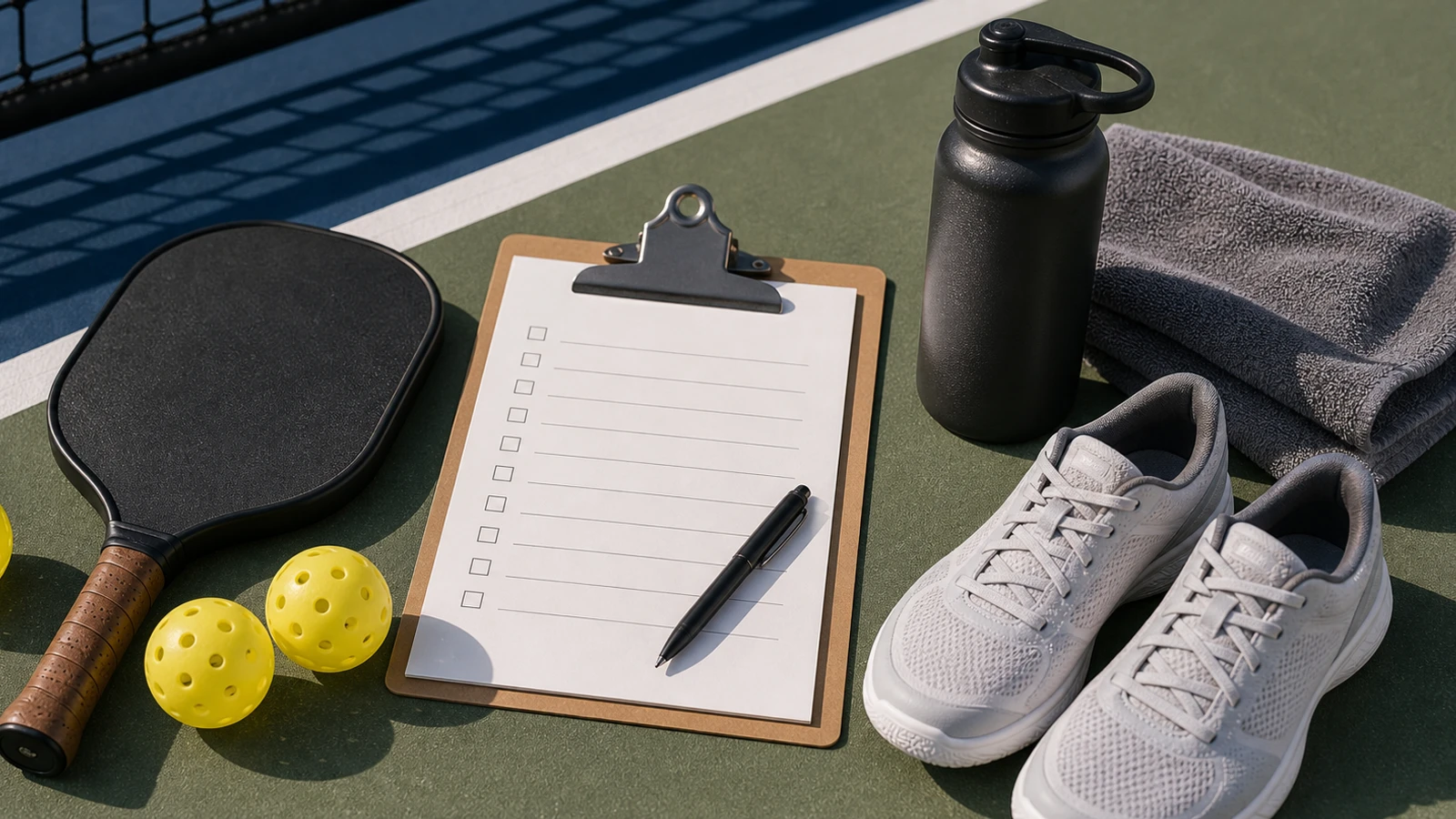
Playing your first sanctioned pickleball tournament is a meaningful step. The game feels different when your DUPR is on the line — even players who win every rec session struggle in their first tournament because the format, mindset, and small logistical details are new.
This is the complete checklist: what to do beforehand, what to bring, and what to expect on tournament day. Following it doesn’t guarantee a win, but it removes most of the surprises that derail first-timers.
4–6 weeks before
1. Pick the right tournament
First-timers should choose a local, 1-day, sanctioned tournament in the bracket just below your self-assessed level. If you rec-play at 3.5, enter a 3.0 bracket. You’re not sandbagging — you’re compensating for tournament nerves that shave ~0.3 off your actual play.
Find tournaments at:
- PickleballBrackets.com — largest US platform
- PickleballTournaments.com — another large registry
- DUPR events — usually posted on DUPR’s app
- Your local club’s newsletter — hidden gems often here
2. Register
Registration flow:
- Create a profile on PickleballBrackets (or DUPR).
- Find the tournament; check event details (format, surface, ball type).
- Select your division and skill level.
- Pay the entry fee (typically $25–$60 per event).
- Select your partner for doubles (or use the “partner needed” board).
Register at least 3 weeks ahead. Last-minute registrations are often waitlisted.
3. Find a partner (for doubles)
Your first tournament is much easier with a partner you’ve played with before — at least 10 rec sessions together. A partner who knows your positioning tendencies and communication style reduces tournament-day stress significantly.
If you don’t have a partner: use the “players needing a partner” tab on PickleballBrackets. Message potential partners, ask their DUPR and play style, and schedule at least two practice sessions before the event.
4. Practice match-play format
Tournaments play to 11, win by 2. Side-outs matter. Scoring is call-by-call. If you only play casual rec, find a partner for full best-of-three match simulations. Do this 2–3 times in the weeks before the tournament.
1 week before
5. Equipment check
Inspect your paddles:
- Face texture intact (not worn smooth)
- Grip tape fresh and tacky
- Edge guard secure
Bring at least two paddles. If one breaks or a string comes loose, you need a backup. Pros always bring three.
6. Break in your shoes
If you bought new shoes for the tournament, play at least 6 hours in them first. New shoes cause blisters; broken-in shoes don’t.
7. Check the ball type
Most US tournaments use Franklin X-40 or Dura Fast 40. Both are outdoor balls. Confirm which one your tournament uses and drill with exactly that ball for the final week. They play slightly differently — see our indoor vs outdoor balls guide.
8. Pre-register for check-in
Many tournaments offer early check-in the night before or the morning of. Taking advantage avoids day-of stress.
Tournament day: what to bring
Pack this the night before:
| Category | Items |
|---|---|
| Paddles | 2 paddles (primary + backup) |
| Balls | 3–5 fresh outdoor balls (even though tournaments provide them) |
| Grip supplies | 2 fresh overgrips, grip tape |
| Clothing | 2 shirts (you’ll sweat through one), athletic shorts, athletic socks × 2 |
| Shoes | Your tournament shoes + a backup pair |
| Nutrition | Water (2L), sports drink, easy snacks (bananas, energy bars) |
| Medical | Sunscreen, blister bandages, pain reliever, any personal medication |
| Sun protection | Hat, sunglasses, sun sleeves if sensitive |
| Paperwork | ID, registration confirmation email |
| Extras | Small cooler (hot tournaments), towel, phone charger |
Pack everything in a dedicated tournament bag the night before. Don’t scramble in the morning.
At the venue
9. Arrive 45 minutes early
Check-in, find your bracket on the display, locate your court, and identify where your first match will start. This buffer prevents rushing.
10. Warm up longer than you think
Tournament nerves keep your heart rate elevated even at rest. A proper warm-up:
- 5 minutes mobility (arm circles, wrist stretches, light jogging)
- 5 minutes paddle-in-hand (forehand/backhand alternating groundstrokes)
- 5 minutes dinking with your partner
- 5 minutes serve practice
- Total: 20 minutes minimum
11. Know your bracket format
Double-elimination is most common at local tournaments — you can lose one match and still play. Round-robin has everyone play everyone; highest win count takes the bracket. Pool play → single elimination seeds your pool results into a cut-off round.
Check the tournament director’s format announcement. Plan your day accordingly.
During matches
12. Play one shot at a time
Tournament nerves make players rush. Between points, reset: take a breath, place your feet in the serving box, look at your partner, call the score. This simple reset adds 10–15 seconds per point and slows everything down to your tempo.
13. Communicate with your partner
- Call “mine” or “yours” on every ball in the middle
- Signal stacking before every point where you’re stacking
- Review what worked and what didn’t during 60-second timeouts
14. Don’t over-strategize
First tournaments are for playing your normal game, not deploying new tactics. Stick to the shots you’ve drilled. Fancy new tactics will fail under pressure.
15. Respect the ref
At larger tournaments, you’ll have line judges and a referee. Don’t argue close calls — you won’t win. Note the call and move on. Saving mental energy for the next point is worth more than litigating the last one.
Between matches
16. Recovery routine
After each match:
- Drink 500ml water (more if hot)
- Eat a small carb source (half a banana, an energy bar)
- Rest your legs — sit or lie down, don’t pace
- Light stretching (hip flexors, calves, shoulders)
- Change shirt if soaked
17. Review with your partner
Briefly, not exhaustively. “They kept attacking my backhand — should I stack to cover middle?” A 2-minute conversation between matches often gains you points in the next match.
After the tournament
18. Upload your results
Tournament results upload to DUPR automatically within 24–48 hours of the event ending. Check dupr.com in the days after to see your rating update.
19. Take notes
Within 24 hours, write down:
- What went well (shots that worked)
- What went wrong (shots that failed under pressure)
- Physical notes (did you cramp, get blisters, run out of energy?)
- Mental notes (nerves at which moments?)
These notes are your single most valuable improvement asset. Review them before your next tournament.
20. Recover
48 hours of easy movement only. Tournaments are harder on your body than rec play — the extra intensity and matches add up.
Common first-tournament mistakes
- Playing too high a bracket. Adjust expectations downward for your first event.
- Forgetting water. Tournaments run long; hydration is non-negotiable.
- Skipping warmup. First matches are lost to cold muscles more than to skill gaps.
- Overthinking strategy. Play your normal game.
- Not eating. Tournament days are 6–10 hours. You need fuel.
- Wearing new shoes. See above — blisters are preventable.
- Forgetting a backup paddle. One mid-match paddle failure ends your tournament if you have no backup.
Frequently asked questions
- How do I register for my first pickleball tournament?
- Create a profile on PickleballBrackets.com or the DUPR app, search tournaments by location and date, select a division at your self-assessed level, pay the entry fee (usually $25–$60 per event), and confirm your partner for doubles. Register at least 3 weeks before the event to avoid the waitlist.
- What level bracket should I play in my first tournament?
- Play one level below your self-assessed rec-play level. If you play rec at 3.5, enter 3.0. Tournament nerves typically shave 0.3 off your actual play for first-timers. This isn't sandbagging — it's calibration. You can move up in your next event.
- How long does a pickleball tournament day last?
- Plan for 6–10 hours depending on format and your performance. Double-elimination brackets of 12+ teams can stretch to a full day. Bring meals, lots of water, and don't expect to be done early.
- Do I need a DUPR rating to play in a tournament?
- Most sanctioned tournaments don't require a pre-existing DUPR rating — they'll generate or update one from your results. Some high-level brackets require minimum DUPR eligibility, but 3.0 and 3.5 brackets are almost always open to anyone who self-rates honestly.
- What happens if my partner cancels last minute?
- Most tournaments allow a partner swap up to 24 hours before check-in. After that, contact the tournament director — some allow walk-in replacement partners from the 'partner needed' board. Worst case, you forfeit the entry fee but can register as a spectator.
- Should I buy a new paddle right before a tournament?
- No. Your paddle muscle memory is tuned to what you've been playing with. A new paddle, even a better one, introduces inconsistency under pressure. Play your first tournament with the paddle you've used for at least the last 4 weeks. Upgrade after, not before.
Sources and further reading
- Pickleball.com: How to Register for a Tournament
- PB5star: Step-by-Step Tournament Entry
- DUPR Blog: Pickleball Tournaments Explained
- USA Pickleball Tournaments
- Related: DUPR Rating Chart · 2026 Serve Rule Changes · Stacking Explained
Last updated May 11, 2026.
The Signal Brief
One useful dispatch each week.
One sharp take, three things worth reading, and the week's buying signals.