
Pickleball
Third Shot Drop Speed: How Fast Should It Actually Be?
The right third-shot drop travels 19–23 mph depending on direction. Hit it too slow and opponents attack; too fast and it pops up. Here's the technical guide.
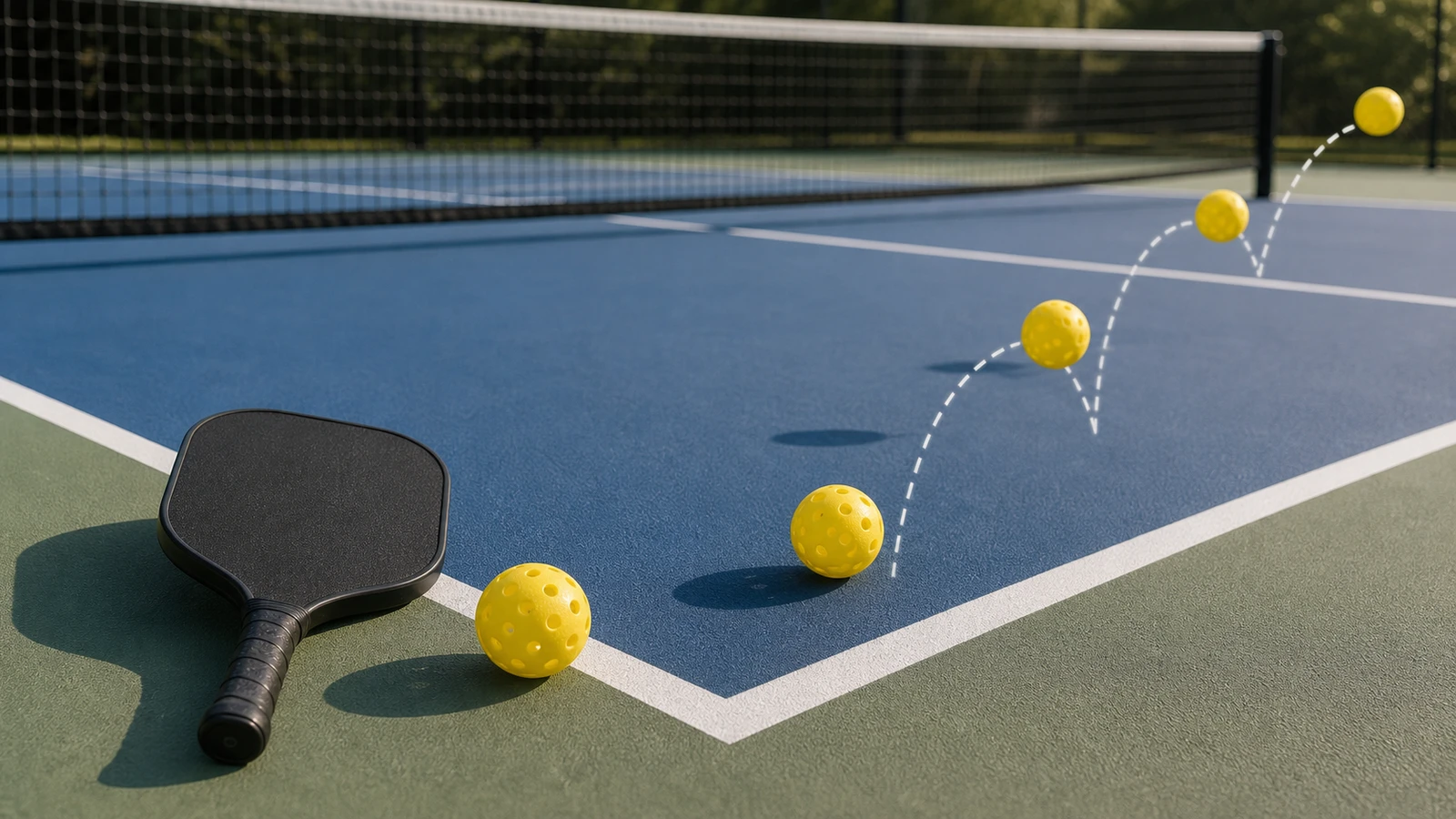
The third-shot drop is the shot that separates rec weekend players from the ones who actually win matches. But most coaching content explains how to swing without specifying how fast the ball should move. Without that number, players default to one of two failure modes: a floaty arc that opponents attack, or a hard shot that pops up at the kitchen line.
The target speeds below come from ball-tracking data on pro and advanced amateur players. Use them as calibration targets when you drill.
Why speed matters
The third-shot drop is trying to do two contradictory things:
- Slow enough that it doesn’t pop up over the kitchen line where opponents can attack.
- Fast enough that it reaches the kitchen on the far side and doesn’t land short on your own side.
Too slow → arc peaks on your side of the net, opponents step in and drive the reply into the ground. Too fast → reaches the opponent’s kitchen with energy left, they pop it back at you with pace.
The speed window is narrower than most players realize. Miss by 3 mph in either direction and the shot fails.
The specific numbers by shot type
Down-the-line drop (baseline → same-side kitchen)
Target speed: 19–20 mph
This is the shortest distance third-shot drop (~22 feet), so the ball needs less energy to reach the kitchen. 19 mph gives you margin — the ball lands in the deep kitchen with almost no pace, making it nearly impossible to attack.
Cross-court drop (baseline → diagonal kitchen)
Target speed: 22–23 mph
Cross-court drops travel roughly 30 feet — 35% farther than down-the- line. The extra speed compensates. At 22 mph, the ball arrives in the kitchen with enough bounce to be challenging, but without enough pace to punish.
Transition drop (mid-court → kitchen)
Target speed: 15–17 mph
If you’re already at mid-court (because your third shot was a drive or you advanced on the opponent’s weak return), the distance to the kitchen is about 12–15 feet. Much less energy needed. Players who transfer baseline-drop speed to mid-court consistently overhit.
How to measure your actual speed
You don’t need a radar gun. A phone + video is enough:
- Film your drop from the side at 120 fps (60 fps works, 120 is better for accuracy).
- Count frames between paddle contact and the ball’s apex (peak of its arc).
- Measure the arc length (horizontal distance traveled) using court reference points — the no-volley zone line is 7 feet from the net, the baseline is 22 feet.
- Calculate: distance (feet) / time (seconds) × 0.682 = mph.
Example: ball travels 25 feet in 0.9 seconds → 25/0.9 × 0.682 = 18.9 mph.
Easier: use a ball machine at fixed speeds to feel what 19 mph, 22 mph, and 17 mph look like. Then replicate the feel without the machine.
Apex height: the other variable
Speed alone isn’t enough. The drop’s arc shape matters equally.
Target apex: 8–10 feet above the net’s low point (34 inches).
That means the ball reaches its peak height roughly 11–13 feet above the ground, somewhere around the middle of the court (depending on your contact point). From there it falls into the far kitchen.
Too low an arc (apex under 7 feet above net) → the ball stays attackable because opponents don’t need to reach up for it. Too high an arc (apex over 12 feet) → gives opponents too much time to set up, and the ball lands with vertical energy that can be swatted down.
The ideal trajectory shape
If you plotted a perfect third-shot drop on graph paper:
- Departure angle: roughly 30 degrees above horizontal, coming off the paddle face
- Peak height: 11–13 feet (8–10 ft above net)
- Peak location: around 8–10 feet past the net, into your opponent’s side
- Landing zone: back third of the kitchen, not the front third
- Landing angle: around 45 degrees, so the ball loses most of its horizontal energy on the bounce
Common technique errors by symptom
Ball pops up at the kitchen (opponent attacks)
Symptom: your drop arrives too high to the opponent, they swat it down.
Cause: paddle face too open at contact + too much lift. You’re trying to “lift” the ball over the net instead of letting the natural arc do the work.
Fix: square the paddle face more; reduce upward swing motion. Let the ball’s forward momentum carry it over the net.
Ball lands short (on your side)
Symptom: ball doesn’t make it over or lands barely past the net.
Cause: not enough forward power; arc too steep upward instead of forward.
Fix: more forward weight transfer; slightly flatten the arc. Think “push the ball into the kitchen” not “lift the ball over the net.”
Ball reaches the kitchen with pace (opponents counter-drop)
Symptom: your drop reaches the kitchen but with enough speed that opponents can hit a controlled return.
Cause: too much pace on contact; swinging too hard.
Fix: reduce swing speed 10–15%. Remember the target is 19–22 mph, not 30+. A softer, slower stroke with a larger follow-through beats a fast short punch.
Drilling speed calibration
A 30-minute drill block:
- Slow drop: 10 reps at ~15 mph (a soft lob into the kitchen). Feels underpowered.
- Target drop: 10 reps trying to hit 19 mph (down the line) or 22 mph (cross-court). Feels measured.
- Fast drop: 10 reps at ~26 mph (too fast). Feels rushed and pops up.
- Random: 10 reps at your target speed, eyes closed for the follow-through (force proprioception).
The slow/target/fast sandwich helps your body learn the feel of the correct speed. Most players only ever practice “as hard as I can hit it,” which is exactly the wrong calibration.
Frequently asked questions
- How fast should a pickleball third-shot drop be?
- Target 19–20 mph for down-the-line drops and 22–23 mph for cross-court drops from the baseline. These speeds let the ball reach the deep kitchen without enough pace for opponents to attack. Transition drops (from mid-court) should be slower, around 15–17 mph.
- Why do my third-shot drops keep popping up?
- Two most common causes: (1) paddle face too open at contact — you're trying to lift the ball over the net rather than letting the natural arc carry it, or (2) too much pace — the ball arrives in the kitchen with enough energy that it bounces high. Square the paddle face and reduce swing speed 10–15%.
- What's the difference between a drop and a drive on the third shot?
- A drive is a hard, flat shot intended to force an error or force opponents back. A drop is a soft, arcing shot intended to land in the opponent's kitchen, giving you time to advance to the kitchen line. The drop is safer but harder to execute; the drive is easier but more attackable.
- Should I always hit a third-shot drop?
- Not always. Drive when (a) opponents have poor reaction time, (b) your return landed them deep and their reply is weak, or (c) the rally context favors aggression. Drop when (a) both opponents are at the kitchen already, (b) your drop technique is reliable, or (c) you specifically want time to advance. Most rec 3.5 players should default to drops; most pros mix it ~60% drops / 40% drives.
- How long does it take to develop a reliable third-shot drop?
- For most players: 3–6 months of regular drilling before drops become 60%+ reliable under match pressure. Drops are the single biggest investment of practice time in pickleball — 20 minutes of focused drop drilling per week matters more than any paddle upgrade.
- Do I need a special paddle for the third-shot drop?
- Not strictly, but control-oriented paddles with longer dwell time make drops easier to execute consistently. Paddles with PureFoam cores (Selkirk Project 006), thick polymer cores (Selkirk LUXX 20mm), or softer face materials give you a larger margin of error on drop shots than stiff thermoformed paddles.
Sources and further reading
- The Dink: Science-Backed Drop Technique
- The Dink: Modern Third-Shot Drop Guide
- Dinking Pickles: Ultimate Drop Shot Guide
- The Dink: Hybrid Roll Drop Advanced Technique
- Related: Paddle Weight Guide · Best Paddles for Intermediate 3.5–4.0
Last updated May 9, 2026.
The Signal Brief
One useful dispatch each week.
One sharp take, three things worth reading, and the week's buying signals.