
Espresso
Best Super-Automatic Espresso Machines (2026)
Super-automatics grind, brew, and froth in one touch. Five machines from $700 to $4,500, and who should buy which tier.
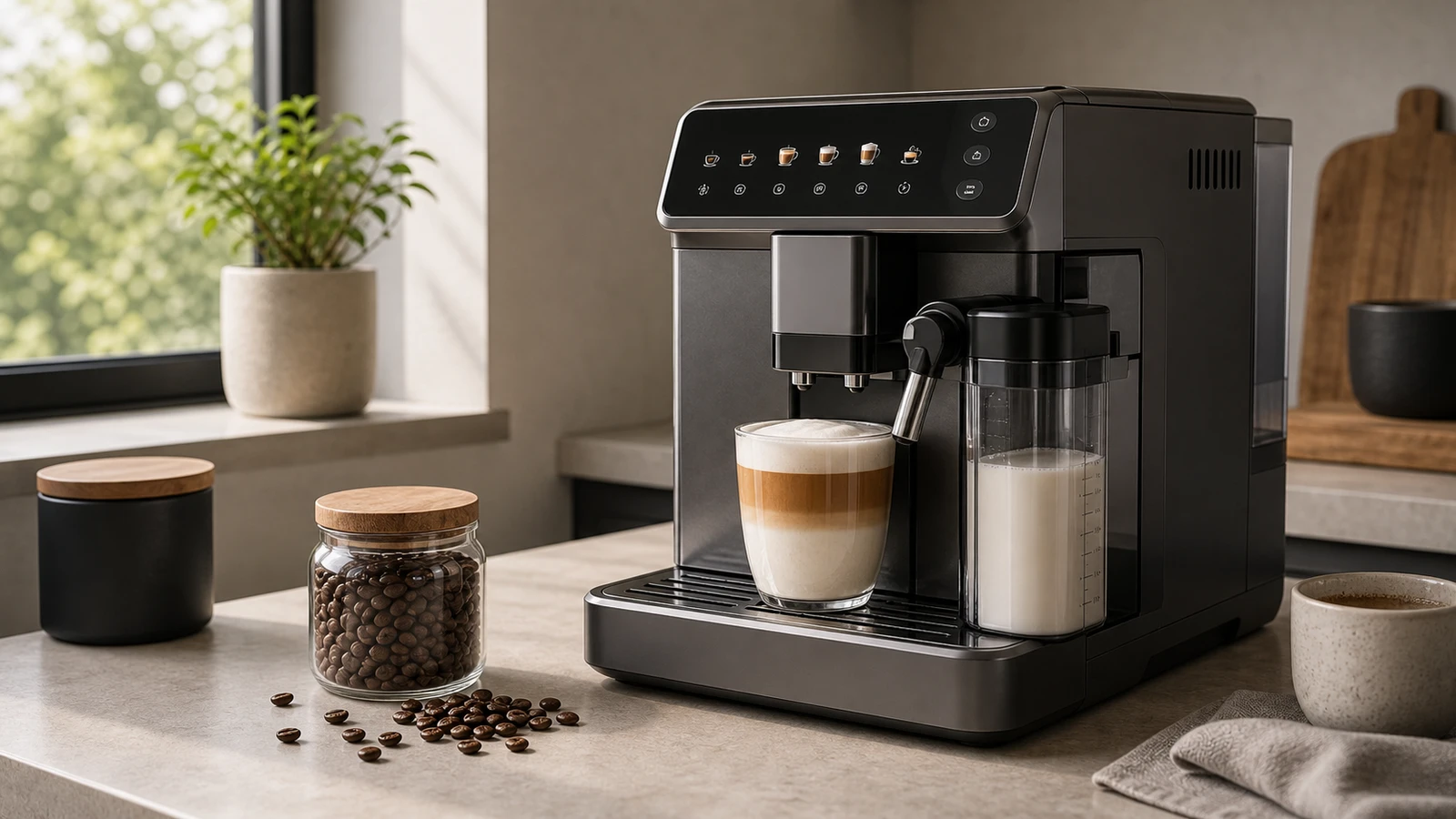
Super-automatic espresso machines do everything in one touch: they grind the beans, dose them, tamp them, pull the shot, froth the milk, and deliver a drink. You press one button, you get a cappuccino.
The trade-off is obvious: you give up control, you pay a premium for automation, and the espresso is never as good as a skilled manual shot. What you gain is convenience — real, significant convenience, especially if multiple people use the machine.
Here are five super-automatics worth owning in 2026, from $700 entry point to $4,500 restaurant-grade home use.
What a super-automatic does
A super-automatic integrates five machines in one:
- Grinder — built-in conical or flat burr, grinds per shot
- Dosing system — portions grounds automatically
- Tamper — some models auto-tamp, some bypass with pressurized baskets
- Espresso brewer — pulls the shot
- Milk frother — real steam wand OR carafe-based auto frother
You press one button. You get a drink. Cleanup is also automated — most models auto-rinse after each use.
The super-auto trade-off
What you gain
- Consistency — every shot is (roughly) the same
- Zero skill required — anyone in the household can make a drink
- Fast — 30–45 seconds from button press to drink
- Cleanup — automatic rinsing, drip tray collection
- Multiple drinks — most models store 5–15 drink programs
What you lose
- Shot quality ceiling — super-autos use pressurized baskets that mask bad extraction; espresso is technically “cafe-style” but rarely excellent
- Flexibility — can’t tune grind + dose + yield per bean
- Repairability — complex internals, expensive repairs after 3–5 years
- Price per pour — $800–4,500 upfront vs $400 for a semi- automatic + grinder that produces better espresso
When super-auto makes sense
- You’ll make 3+ drinks/day
- Multiple people use the machine (kids, guests, non-coffee-skilled spouse)
- You value time more than shot quality
- You drink mostly milk drinks (cappuccinos, lattes)
- You want consistent coffee with zero learning curve
When it doesn’t make sense
- You drink only 1–2 drinks/day (not worth the premium)
- You’re an espresso purist (shot quality will frustrate you)
- You like learning and tinkering (manual machines are more rewarding)
- You’re budget-conscious ($800 buys a better semi-auto + grinder)
Top 5 ranked
1. Philips 3200 LatteGo — best value (~$1,199)
Score: 9.0 / 10
Philips 3200 LatteGo is the super-auto most people should buy. It’s a generation ahead of the budget tier but avoids the steep jump to Jura pricing.
- Milk system: LatteGo carafe (2-piece, dishwasher safe) — cleaner than most auto-frothers
- Drink variety: 5 drink programs (espresso, coffee, americano, cappuccino, latte macchiato)
- Grinder: ceramic burrs, adjustable across 12 settings
- Water tank: 1.8L
- Warm-up: 40 seconds
Pros: LatteGo is genuinely easy to clean (2 minutes between uses), quiet grinder, reliable 3–5 year lifespan, reasonable repair costs.
Cons: pressurized baskets = decent but not excellent espresso, limited drink programming vs premium tier, plastic construction.
Best for: households making 3–5 milk drinks per day who value easy cleaning and zero learning curve.
2. De’Longhi Magnifica Evo — best under $1,000 (~$799)
Score: 8.5 / 10
De’Longhi has made the Magnifica line for 20+ years. It’s the household-name entry super-auto.
- Milk system: steam wand (panarello style, not auto frother)
- Drink variety: 4 programmable drinks
- Grinder: integrated conical burr, 13 settings
- Water tank: 1.8L
- Warm-up: 45 seconds
Pros: lowest price for a real super-auto, reliable brand, simple interface, steam wand gives slightly better milk texture than carafe systems (if you have the skill).
Cons: plastic construction, smaller drink variety, no auto- frothing (you manually position the wand). If you want fully automated lattes, go to Philips 3200 instead.
Best for: under-$1,000 buyers who want super-auto convenience but can spend 30 seconds per drink on milk wand positioning.
3. Jura E8 — best premium (~$2,199)
Score: 9.3 / 10
Jura is Swiss — the premium bracket of super-autos. The E8 is their entry-premium model and widely considered the best buy in the Jura lineup.
- Milk system: auto-frother from milk carafe (hot milk, cold milk, latte foam)
- Drink variety: 17 programmable drinks
- Grinder: Aroma G3 burrs — quieter than De’Longhi/Philips, longer-lasting
- Water tank: 1.9L with Claris filter
- Warm-up: 25 seconds (fast)
- Bean hopper: 280g
Pros: best-in-class drink variety, quiet operation, beautiful stainless steel build, 10–15 year expected lifespan with service, auto-cleanout cycles.
Cons: expensive, parts cost more to replace, service contracts add up ($100–200/year). Also: Swiss espresso philosophy favors softer extraction — some users prefer bolder espresso.
Best for: households making 5+ drinks/day, buyers who value drink variety and longevity over raw value.
4. Jura Z10 — best top-of-line (~$4,499)
Score: 9.5 / 10
The Z10 is what you buy when money isn’t the primary constraint. Everything is better than the E8: faster, quieter, more durable, more drinks, better milk.
- Milk system: dual milk carafe system (hot + cold together)
- Drink variety: 31 drink programs (including cold brew)
- Grinder: Product Recognizing Grinder — auto-detects bean type
- Water tank: 2.4L
- Warm-up: 20 seconds
- Bean hopper: 300g
- Expected lifespan: 15–20 years with service
Pros: everything. Best milk, best espresso (for super-auto tier), quietest, fastest, longest-lasting.
Cons: price. Also: $500+ annual maintenance if you follow recommended servicing.
Best for: high-end household where someone makes 10+ drinks/day and the machine will be used for 15+ years.
5. Breville Oracle Touch — hybrid super-auto (~$2,799)
Score: 8.8 / 10
Not quite a pure super-auto — the Oracle Touch has an auto steam wand (semi-automatic milk) and actual 58mm portafilter (not a pressurized basket). It grinds and doses automatically but you manually lock in the portafilter.
- Milk system: auto steam wand (you position, it controls)
- Drink variety: touchscreen with custom recipes
- Grinder: conical burr, integrated
- Water tank: 2.5L
- Warm-up: 3 seconds (industry-leading)
- Hybrid feature: can make manual espresso if you want
Pros: the best espresso quality of any super-auto — 58mm basket means closer-to-real espresso. Fast. Looks beautiful.
Cons: more manual steps than pure super-auto (you handle the portafilter), less “set and forget” than Jura. Not cheaper than Jura E8.
Best for: users who want super-auto convenience most of the time but occasionally want to pull a real manual espresso shot.
Quick decision tree
Budget $700–1,000: De’Longhi Magnifica Evo Budget $1,100–1,500: Philips 3200 LatteGo Budget $1,800–2,500: Jura E8 OR Breville Oracle Touch Budget $3,000–5,000: Jura Z10 Budget $5,000+: look at Jura Z10 OR commercial machines
Common rejections (why I’d NOT buy super-auto)
If you drink only straight espresso
A $500 Gaggia Classic Evo Pro + $300 grinder = better pure espresso than any super-auto under $3,000. Super-autos optimize for milk drinks.
If you drink only 1 coffee per day
Spending $1,200+ to replace a $300 machine for one drink doesn’t math. Break-even is 5+ years of savings vs cafe trips, which is longer than most super-auto lifespans.
If you’re a hobbyist
Super-auto removes the fun parts. If you enjoy espresso as a craft, a semi-auto + separate grinder is more rewarding.
If you don’t own your home
Super-autos are $1,200–4,500 appliances that don’t move well. If you rent and move frequently, consider semi-auto (smaller, modular).
Maintenance reality
Super-autos require more maintenance than semi-autos because they have more moving parts.
Daily
- Empty drip tray (fills after 10 drinks)
- Rinse milk carafe (Philips/Jura)
- Auto-rinse completes on most machines
Weekly
- Deep clean brew group (remove, rinse under water)
- Descale water tank if not using filter
- Clean milk carafe thoroughly
Monthly/Quarterly
- Descale machine (every 2–3 months depending on water hardness)
- Clean coffee grounds container thoroughly
- Check grinder burr wear
Annually
- Professional servicing ($100–300)
- Replace water filter
- Burr inspection/replacement (every 3–5 years)
Skipping maintenance shortens lifespan dramatically. A Jura that lasts 15 years with servicing lasts 5 years without.
Frequently asked questions
- Is a super-automatic worth $1,000+?
- If you make 3+ milk drinks per day and value convenience, yes. Break-even vs cafe trips is usually 4–6 months. If you drink only 1 coffee per day or only black espresso, a $500 semi-auto + grinder is better value.
- Philips 3200 vs De'Longhi Magnifica Evo — which is better?
- Philips 3200 has better milk system (LatteGo auto-frothing is dishwasher safe and cleaner than De'Longhi's steam wand). De'Longhi is $400 cheaper. If budget allows, Philips wins for convenience. For cost-sensitive buyers, De'Longhi is still a solid choice.
- Is Jura worth the price premium?
- For heavy users (5+ drinks/day) who will use the machine 10+ years, yes — quality, lifespan, and service network justify the premium. For casual users (1–3 drinks/day), Philips or De'Longhi give 80% of the experience at 40–60% of the price.
- Do super-automatics make real espresso?
- They make something that looks and tastes like espresso. Pressurized baskets mask extraction quality, so it's technically 'cafe-style' but rarely excellent by specialty standards. A well-dialed manual machine produces better espresso. Super-auto wins on consistency, not peak quality.
- How long do super-automatics last?
- Budget (Philips, De'Longhi): 5–8 years with maintenance. Premium (Jura): 10–15 years with professional servicing. Without maintenance, halve those numbers. Super-autos have more internal parts than semi-autos, so failures are more likely over time.
- Can I use any beans in a super-automatic?
- Yes, but use fresh beans (7–30 days from roast). Oily dark-roast beans (French roast, Italian roast) can clog grinders — super-autos prefer medium to medium-dark roasts. Avoid flavored beans (vanilla, hazelnut beans) — the oils damage internals.
Sources and further reading
- Jura Official
- Philips Coffee Official
- Seattle Coffee Gear: Super-Automatic Reviews
- Home-Barista Forum: Super-Auto Discussion
- Related: Best Budget Espresso Machines · How to Make a Latte at Home · Espresso guides
Last updated April 23, 2026. See our editorial policy for methodology. Reviews based on aggregated research, spec comparisons, and community reports — not independent physical testing.
The Signal Brief
One useful dispatch each week.
One sharp take, three things worth reading, and the week's buying signals.