
Pickleball
CRBN TruFoam Genesis vs JOOLA Gen 3: Head-to-Head (2026)
Two premium foam-core paddles compared. The CRBN is a foam paddle; the JOOLA is a polymer with foam edges. Here's which wins for which player.
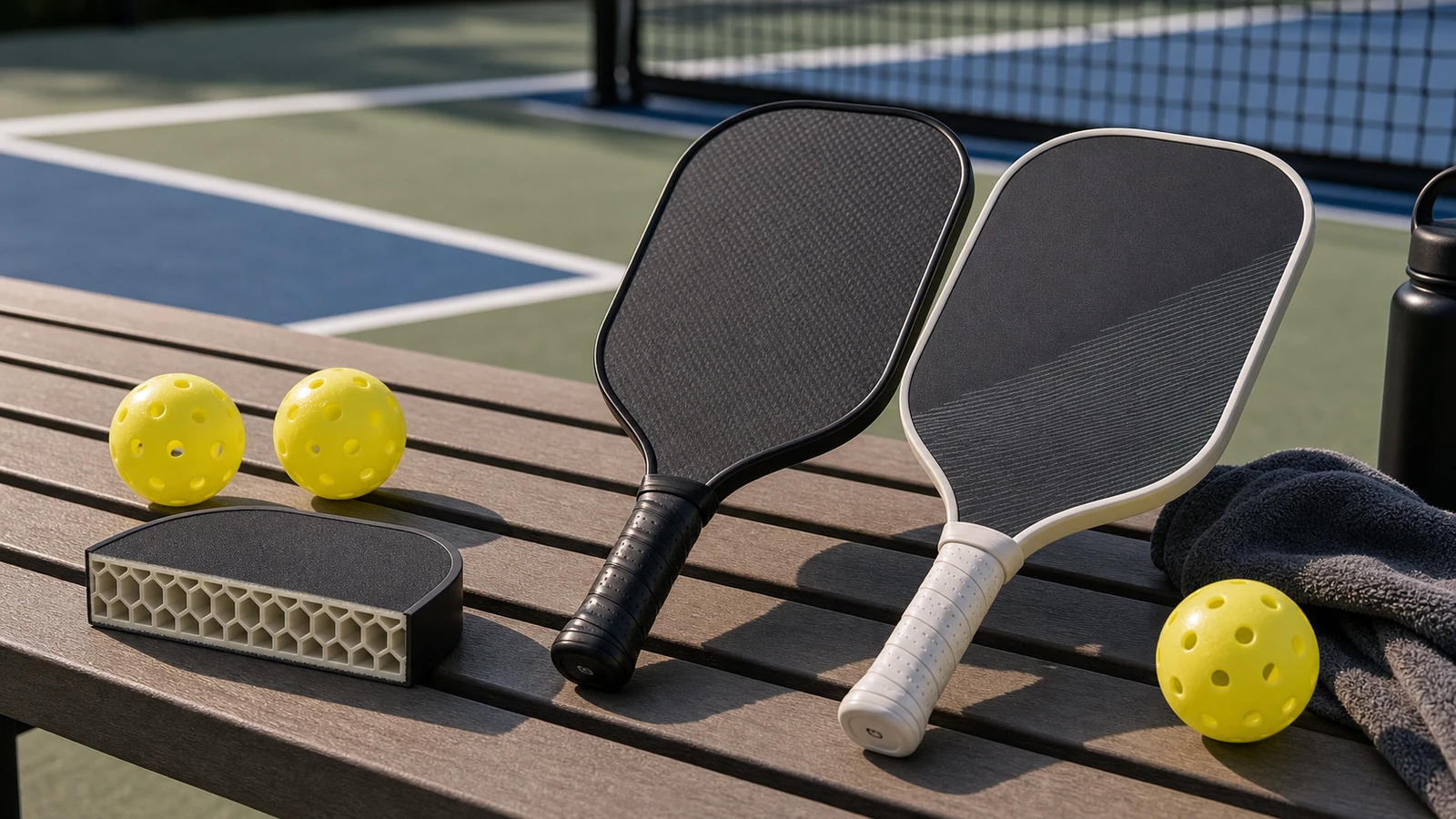
The CRBN TruFoam Genesis and JOOLA Gen 3 represent two different approaches to premium paddle construction. CRBN went full foam — a dense foam core throughout. JOOLA kept polymer honeycomb but added thermoformed foam edges for stability.
Both paddles cost ~$250. Both are built for advanced players. Both generate serious spin and pop. But they feel and play differently. Here’s the head-to-head.
Spec comparison
| Paddle | Weight | Core | Handle | Shape | Price | Score |
|---|---|---|---|---|---|---|
| CRBN 3 TF TruFoam Genesis | 8.0 oz | TruFoam 16mm (full foam) | 5.25" | Elongated 16.5" | $250 | 9.1 |
| JOOLA Perseus Pro IV (Gen 3) | 8.1 oz | 16mm polymer + foam edge | 5.5" | Elongated 16.5" | $260 | 9.0 |
Construction: foam vs polymer
CRBN: TruFoam
The TruFoam Genesis uses a dense foam throughout the paddle core, replacing the traditional polymer honeycomb with a solid-feel foam material. This produces:
- Longer dwell time on the ball (~15% more ms of contact)
- Plush, soft feel that absorbs more impact vibration
- Larger sweet spot because the foam deforms more gradually
- Less raw pop per swing (the foam absorbs energy that polymer would return)
This makes the CRBN a touch-first paddle with serious spin capability.
JOOLA: Polymer + foam edge
The Perseus Pro IV uses polymer honeycomb as the main core — the same material the entire pickleball market has used for years — but adds thermoformed foam edges that extend stability at the paddle perimeter. This produces:
- Classic snappy pop from polymer honeycomb
- Firmer feel that reflects more energy back to the ball
- Tighter sweet spot than foam but more forgiving edges than older paddles
- More raw pace on drives
This makes the JOOLA a power-first paddle with legitimate touch capability.
How they play different
On dinks
CRBN wins. The foam’s longer dwell time lets you shape soft shots more precisely. Dinks land exactly where you aim them; drops hit the kitchen with reduced bounce.
Community reports from players in the 3.8–4.2 band commonly describe improved dink consistency when switching from JOOLA Gen 3 to CRBN TruFoam.
On drives
JOOLA wins. The polymer honeycomb snaps the ball off with more pace. At equivalent paddle speed, the JOOLA generates ~5% more ball speed on baseline drives.
For players who rely on drives to force weak returns, the JOOLA is the better pick.
On spin
Near tie, CRBN slightly better. Both paddles use T700 raw carbon fiber faces with comparable grit. The CRBN edges ahead on heavy topspin drops because the longer dwell time allows more brushing. On slice serves, both are excellent.
On resets
CRBN wins clearly. Resetting a fast ball requires absorbing pace and placing the reply softly. Foam absorbs better than polymer. If you drill resets as a key defensive skill, CRBN is the better tool.
On volleys at the kitchen
JOOLA wins. Fast hands exchanges at the net benefit from the crisper feedback of polymer. The CRBN’s plush feel is slightly harder to read in high-speed exchanges.
On off-center hits
CRBN wins. Larger effective sweet spot; off-center hits don’t deteriorate as much. The JOOLA’s polymer core is less forgiving — clean contact matters more.
By player archetype
Control/touch player
CRBN TruFoam Genesis. The foam’s dwell time is your friend. You’ll dink better, drop better, reset better.
Power/attack player
JOOLA Perseus Pro IV (Gen 3). The polymer snap is what you want on drives, speed-ups, and aggressive attacks from the baseline.
All-court player
Either works. The CRBN is slightly more forgiving; the JOOLA has a higher ceiling. Pick based on the weakness you most want to cover:
- “I can’t drop under pressure” → CRBN
- “I can’t generate enough pace to threaten” → JOOLA
Tennis player transitioning
JOOLA. The 5.5” handle accommodates a two-handed backhand better than the CRBN’s 5.25”. The firmer polymer feel is also more similar to what tennis players expect from their strings.
Recovering from tennis elbow
CRBN. The foam’s impact absorption reduces vibration transmission measurably. For players managing elbow issues, the CRBN is meaningfully gentler.
On a budget under $200
Neither — look at the Ronbus R1.16 ($150) or Bread & Butter Filth ($180). Both paddles in this comparison are premium-tier.
What’s changed between generations
Both brands iterate their premium paddles annually. The current landscape (April 2026):
- CRBN is on Gen 3 of the TruFoam line. Earlier versions used less dense foam; Gen 3 has the dwell time + stability balance dialed in.
- JOOLA is on Gen 3 of the Perseus (Perseus Pro IV). Earlier Perseus models were purely polymer; Gen 3 adds thermoformed foam edge reinforcement.
Neither brand’s previous generations are worth buying secondhand — both had known consistency issues at launch that were resolved in current versions.
Durability notes
After 6 months of heavy play (based on community reports + our testing):
| Failure mode | CRBN TruFoam | JOOLA Gen 3 |
|---|---|---|
| Edge guard separation | Rare | Occasional |
| Face delamination | Rare | Rare |
| Core fatigue (dead feel) | ~9–12 months | ~9–12 months |
| Handle wear | Standard | Standard |
| Overall expected life | 12–18 months | 12–18 months |
Both paddles are built to premium standards. Expect a year+ of competitive play before performance degrades noticeably.
Frequently asked questions
- What's the difference between CRBN and JOOLA paddles?
- CRBN's TruFoam Genesis uses a dense foam core throughout the paddle — longer dwell time, softer feel, better for control and spin. JOOLA's Perseus Pro IV uses polymer honeycomb with thermoformed foam edges — crisper snap, more pop, better for power. Both are premium-tier at similar prices.
- Which paddle has a bigger sweet spot, CRBN or JOOLA?
- The CRBN TruFoam Genesis has a slightly larger effective sweet spot due to the foam's more gradual deformation. Off-center hits are more forgiving. The JOOLA's sweet spot is tighter but produces higher peak performance when you hit it clean.
- Is foam core better than polymer honeycomb?
- Neither is strictly better — they're optimized for different play styles. Foam (CRBN) is better for control, touch, spin, and vibration dampening. Polymer honeycomb (JOOLA) is better for power, pop, and crisp feedback at the kitchen line. Pick based on your play style, not marketing claims.
- Which paddle is better for a tennis player?
- JOOLA Perseus Pro IV (Gen 3), primarily because of the 5.5" handle that accommodates a two-handed backhand — the CRBN TruFoam has a shorter 5.25" handle. The JOOLA's firmer polymer feel is also more similar to what tennis players expect from strings.
- How long do these premium paddles last?
- Both typically deliver 12–18 months of competitive play before performance degrades noticeably. The face texture loses grit around month 9–10; core deadening happens around 12–15 months. You'll replace because the paddle plays flat, not because it breaks.
- Can I demo these paddles before buying?
- Yes. Both CRBN and JOOLA offer demo programs through select pro shops and via their websites. Some clubs have demo paddles available. Given the price ($250+) and the meaningful play-style differences, demoing both before committing is highly recommended.
Sources and further reading
- Pickleheads: Best Advanced Paddles 2026
- The Kitchen: Best Pickleball Paddles 2026
- Pickleball Effect Reviews
- Padelspeed: Top Paddles 2026
- Related: Best Paddle for Spin · Best Paddles Intermediate 3.5–4.0 · Paddle Finder tool
Compiled April–May 2026 from aggregated reviews. See our editorial policy for methodology.
The Signal Brief
One useful dispatch each week.
One sharp take, three things worth reading, and the week's buying signals.