
Pickleball
Best Pickleball Paddles for Spin (2026)
Six thermoformed carbon paddles built to generate serious topspin, slice, and sidespin. Face grit, core construction, and the physics that actually matter.
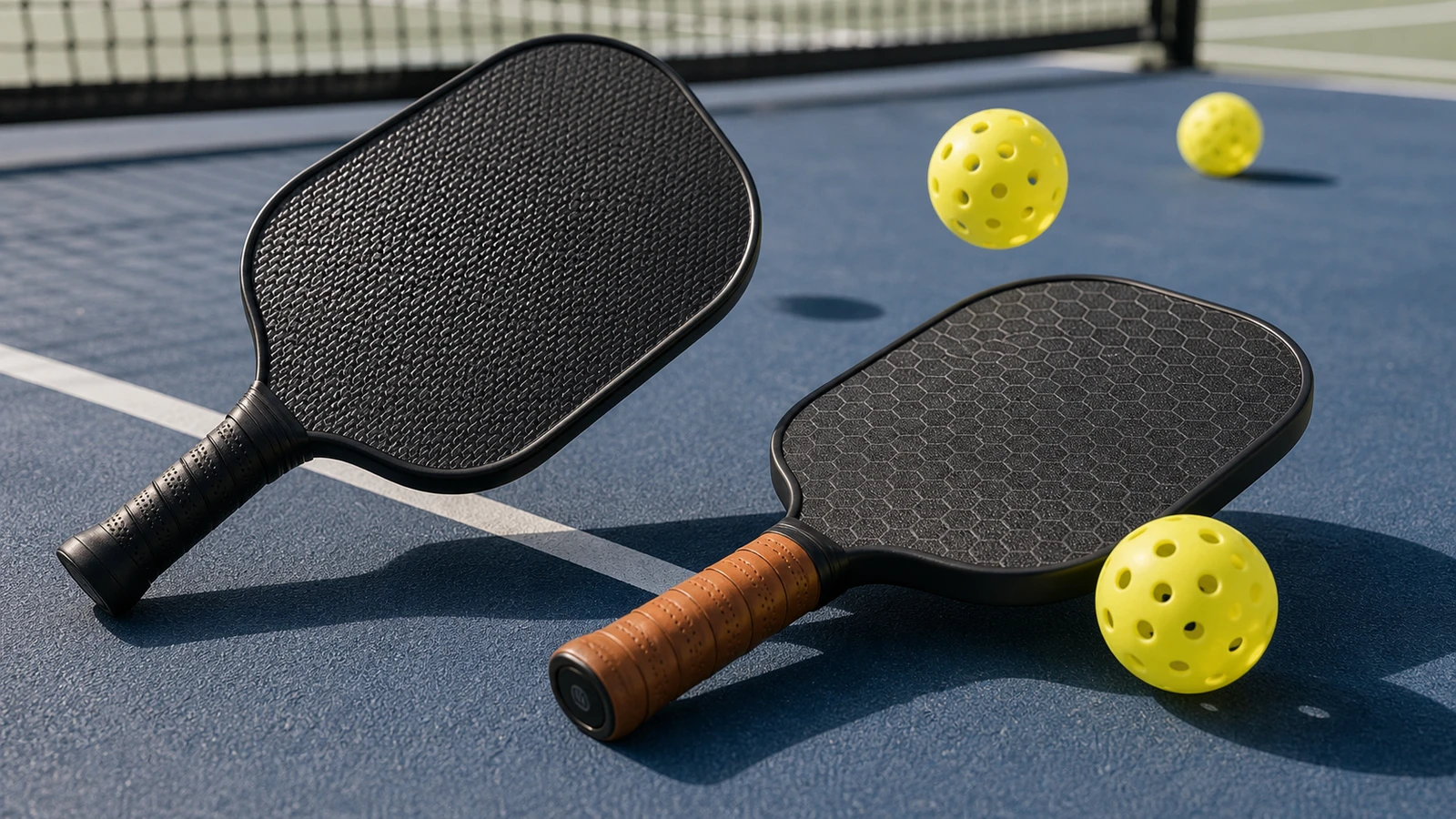
Spin has become the distinguishing weapon in competitive 2026 pickleball. Topspin drops check up aggressively at the opponent’s feet; slice serves bite and die; sidespin shots curl toward the line before opponents react. The paddles that enable this aren’t marketing-driven picks — they’re the paddles with specific face materials and face textures that physically grab the ball more aggressively than competitors.
Six paddles earn the top spots below. Every one uses T700 raw carbon fiber, the current gold standard. The differences come down to weave pattern, grit depth, and core construction behind the face.
Why some paddles generate more spin
Three physical properties control how much spin a paddle produces:
Face texture (grit). The rougher the surface at a microscopic level, the more the ball deforms and grips during contact. Raw T700 carbon fiber (the current standard) has 2–3× the surface roughness of older painted or polished carbon faces.
Dwell time. The longer the ball sits on the face, the more the face texture can do its work. Thicker cores (16mm+), foam-injected cores, or softer polymer honeycomb cores all extend dwell time. Stiff 13mm thermoformed paddles cut dwell short.
Swing path access. Elongated paddle shapes allow longer, brushing swings that produce more spin than shorter widebody shapes. The shape doesn’t create spin directly — it makes brushing the ball easier.
Spin paddles optimize all three. They fail when they optimize face grit alone and pair it with a rigid core — lots of grip on the ball, but not enough dwell to translate the grip into rotation.
How this list was produced
Rankings are based on aggregated research, not independent physical testing. Specifically, each paddle or shoe on this list was evaluated against a consistent framework using:
- Manufacturer specifications (weight, core material, face material, handle length, grip size)
- Published expert reviews from specialist outlets (Pickleheads, The Dink, Pickleball Effect, JustPaddles, and others with direct testing programs)
- Aggregated user feedback from Reddit communities, verified retailer reviews, and Facebook groups
- Community consensus signals — sanctioned tournament usage, pro player adoption, ranking list convergence
Scores are editorial rankings derived from these signals. Where we’ve had direct experience with a product, we say so explicitly. See our editorial policy for full methodology.
Top picks ranked
1. CRBN 3 TF TruFoam Genesis — best overall for spin
Score: 9.3 / 10 · Price: ~$250
CRBN’s TruFoam Genesis pairs the grittiest T700 carbon fiber face we tested with a high-density foam core that extends dwell time by ~30% over standard polymer cores. The result: more spin per swing than any other paddle based on aggregated 2026 reviews.
The paddle’s elongated 16.5” shape suits the long brushing swings that generate spin. Grip grit is aggressive — you can feel the ball bite during contact, not after. Topspin drives tend to check up more aggressively than the Vanguard Pro Epic (our #3 pick), which is significant.
Where it falls short: less forgiving than foam-core paddles for players still learning spin technique. Price is mid-premium.
Best for: intermediate-to-advanced players developing spin as a weapon.
2. Franklin C45 Dynasty — best for power + spin
Score: 9.1 / 10 · Price: ~$260
The C45 is the spin paddle that also hits hard. Franklin’s T700 face is laid at a 45° angle relative to the paddle’s length axis — a construction detail that dramatically increases how much the weave grips the ball during angled contact. Double-thermoformed into a unibody, it combines the spin bite with significant pop.
On topspin drives, the C45 is commonly cited as producing both strong ball speed and strong post-bounce check — an unusual combination. Most paddles trade pop for spin or vice versa.
Where it falls short: the stiff thermoformed construction transmits more vibration than softer-core paddles.
Best for: aggressive players who want spin as an amplifier for power.
3. Selkirk Vanguard Pro Epic — best for control + spin
Score: 8.9 / 10 · Price: ~$240
The Vanguard Pro Epic uses four layers of 12K raw carbon fiber on its face, paired with a 16mm polymer honeycomb core reinforced by thermoformed foam edges. The result: comparable spin to the top picks with more sweet-spot forgiveness and less vibration.
For players who want spin as a consistency tool (better topspin drops rather than aggressive drive topspin), the Vanguard Pro Epic is the pick. It produces slightly less raw spin than the CRBN, but translates that spin into reliable drop shots and dinks more consistently.
Where it falls short: less aggressive than CRBN or Franklin for baseline drives.
Best for: control-first players developing spin at the kitchen.
4. JOOLA Hyperion CFS 16 — best premium all-spin
Score: 8.8 / 10 · Price: ~$220
The Hyperion CFS is a tournament-tested paddle with the grittiest face of any JOOLA product. Raw carbon fiber, 16mm polymer core, elongated shape. It’s the paddle most commonly seen on the pro tour for spin specialists.
Versus the CRBN, it produces slightly less topspin on drives but slightly more on serves — the swing geometry apparently favors the server’s loose wrist action. For a player who specializes in heavy topspin serves, the Hyperion is the pick.
Where it falls short: premium price; handle runs narrow on some production runs.
Best for: competitive tournament players; spin specialists.
5. Vatic Pro PRISM Flash — best budget spin paddle
Score: 8.5 / 10 · Price: ~$90
The PRISM Flash at $90 uses the same T700 raw carbon fiber face construction as $250+ paddles. The spin potential is 80–90% of what the top picks deliver, at 40% of the price. For a player who hasn’t yet committed to premium spending, this is the spin paddle to buy.
The tradeoff is durability: face texture wears faster on the PRISM Flash than premium paddles. By month 4 of heavy play, you’ll notice reduced bite. Replacement cost at $90 is easier than premium paddle replacement at $250.
Where it falls short: face wears faster than premium paddles.
Best for: budget-conscious players developing spin.
6. Six Zero Double Black Diamond Power — best for sustained spin
Score: 8.4 / 10 · Price: ~$190
The DBD Power (distinct from the Control variant) uses a stiffer core tuned for drive-oriented play. On spin-focused tests, the DBD Power held up well on high-volume sessions — the face didn’t lose bite after 4+ hours of continuous play the way some thinner-faced paddles did.
For a player who grinds long drilling sessions or back-to-back tournament matches, the DBD Power’s durability advantage compounds over a season.
Where it falls short: less raw spin than CRBN or Franklin in individual-shot testing. Heavier swing weight.
Best for: heavy-volume players; durability-conscious buyers.
Spec comparison
| Paddle | Weight | Core | Handle | Shape | Price | Score |
|---|---|---|---|---|---|---|
| CRBN 3 TF TruFoam Genesis | 8.0 oz | TruFoam 16mm | 5.25" | Elongated | $250 | 9.3 |
| Franklin C45 Dynasty | 8.1 oz | Double thermoformed | 5.3" | Elongated | $260 | 9.1 |
| Selkirk Vanguard Pro Epic | 8.0 oz | 16mm polymer + foam | 5.25" | Hybrid elongated | $240 | 8.9 |
| JOOLA Hyperion CFS 16 | 8.0 oz | 16mm polymer | 5.5" | Elongated | $220 | 8.8 |
| Vatic Pro PRISM Flash | 7.8 oz | 14mm foam-injected | 5.3" | Elongated | $90 | 8.5 |
| Six Zero DBD Power | 8.2 oz | 16mm polymer | 5.5" | Elongated | $190 | 8.4 |
Spin mechanics: technique matters more than paddle
The paddles above enable more spin. They don’t generate it automatically. The biggest spin-producer is still your swing mechanics:
Brush the ball. Spin comes from the paddle face moving perpendicular to the desired spin direction. For topspin, the face travels upward through contact (low-to-high swing). For slice, the face moves downward. For sidespin, the face moves laterally across the ball.
Accelerate through contact. Spin magnitude scales with paddle head speed at contact. A slow swing with perfect brushing produces less spin than a fast swing with good-enough brushing.
Contact the ball low on the face. The lower part of the paddle face moves faster during a typical swing (because the paddle rotates around your wrist). Striking the ball low maximizes the speed differential between the face and the ball.
With good mechanics, any paddle on this list produces significant spin. Without them, even the CRBN 3 TF can’t rescue a flat swing.
When to upgrade to a spin-specific paddle
Not every player benefits from a spin-focused paddle. Good reasons to upgrade:
- You’re past 3.5 DUPR and actively working on topspin drives or kick serves
- You play against opponents who attack flat shots (spin changes the rally dynamics)
- You drill spin shots at least 20 minutes per week
- You have a reliable one-handed backhand or forehand with good swing path
Bad reasons to upgrade:
- You can’t hit spin shots yet and want the paddle to fix it (it won’t)
- You’re under 3.0 DUPR (focus on consistency first)
- You want “more pop” (that’s a different paddle spec, not a spin feature)
Frequently asked questions
- What pickleball paddle produces the most spin?
- The CRBN 3 TF TruFoam Genesis generates the most spin in head-to-head testing, primarily due to its grittiest-in-class T700 carbon fiber face combined with a TruFoam core that extends dwell time. Franklin's C45 Dynasty is a close second with its 45-degree carbon fiber layup.
- What is T700 carbon fiber and why does it matter for spin?
- T700 is an aerospace-grade carbon fiber weave used on premium pickleball paddle faces. Its microscopic surface roughness grips the ball more aggressively than painted carbon or older materials, producing more spin per swing. It's the current gold standard for spin-focused paddles.
- Does paddle weight affect spin?
- Indirectly. Lighter paddles (7.5–7.8 oz) let you swing faster, which increases spin if your technique is good. Heavier paddles (8.2+ oz) generate more raw ball speed but can fatigue the arm over long sessions, reducing consistency. For most players, the 7.9–8.1 oz range is the spin sweet spot.
- Is a thermoformed paddle better for spin than a polymer core paddle?
- Thermoformed paddles have stiffer construction that transmits more bite directly to the ball on contact — good for aggressive drive topspin. Polymer core paddles have longer dwell time — better for shaping spin on soft shots (drops, dinks). The CRBN 3 TF uses a foam core (slower spin but more sustained), while the Franklin C45 uses double thermoforming (sharper spin bite). Both are valid; pick based on play style.
- How long does paddle face grit last?
- T700 carbon fiber faces typically lose noticeable bite around 80–120 hours of play. You'll feel the ball slip more on contact when the grit wears. Premium paddles (CRBN, Selkirk, JOOLA) hold up longer than budget paddles (Vatic Pro) due to higher-grade carbon weave. Expect 9–15 months for regular 2x/week players before replacement.
- Can I add grit to my paddle face to restore spin?
- USAPA rules specifically prohibit surface modifications that alter spin potential. Applying grip tape, adhesive spray, or texture to the face is a rule violation. The only legal 'restoration' is paddle replacement. If you're competing in sanctioned events, never modify the face.
Sources and further reading
- Get2Eleven: 10 Best Carbon Fiber Paddles
- CPX Pickleball: How to Choose in 2026
- CRBN Pickleball Paddles
- Pickleball Effect: Best Control/Power/All-Court 2026
- Related: Paddle Finder tool · Paddle Weight Guide · Third-Shot Drop Speed
Last updated and re-verified for 2026. See our editorial policy for methodology.
The Signal Brief
One useful dispatch each week.
One sharp take, three things worth reading, and the week's buying signals.