
Pickleball
Pickleball Paddle Grip Size: How to Measure and Choose
Grip size affects control, wrist stability, and elbow strain more than almost any other paddle spec. Here's how to measure and choose correctly.
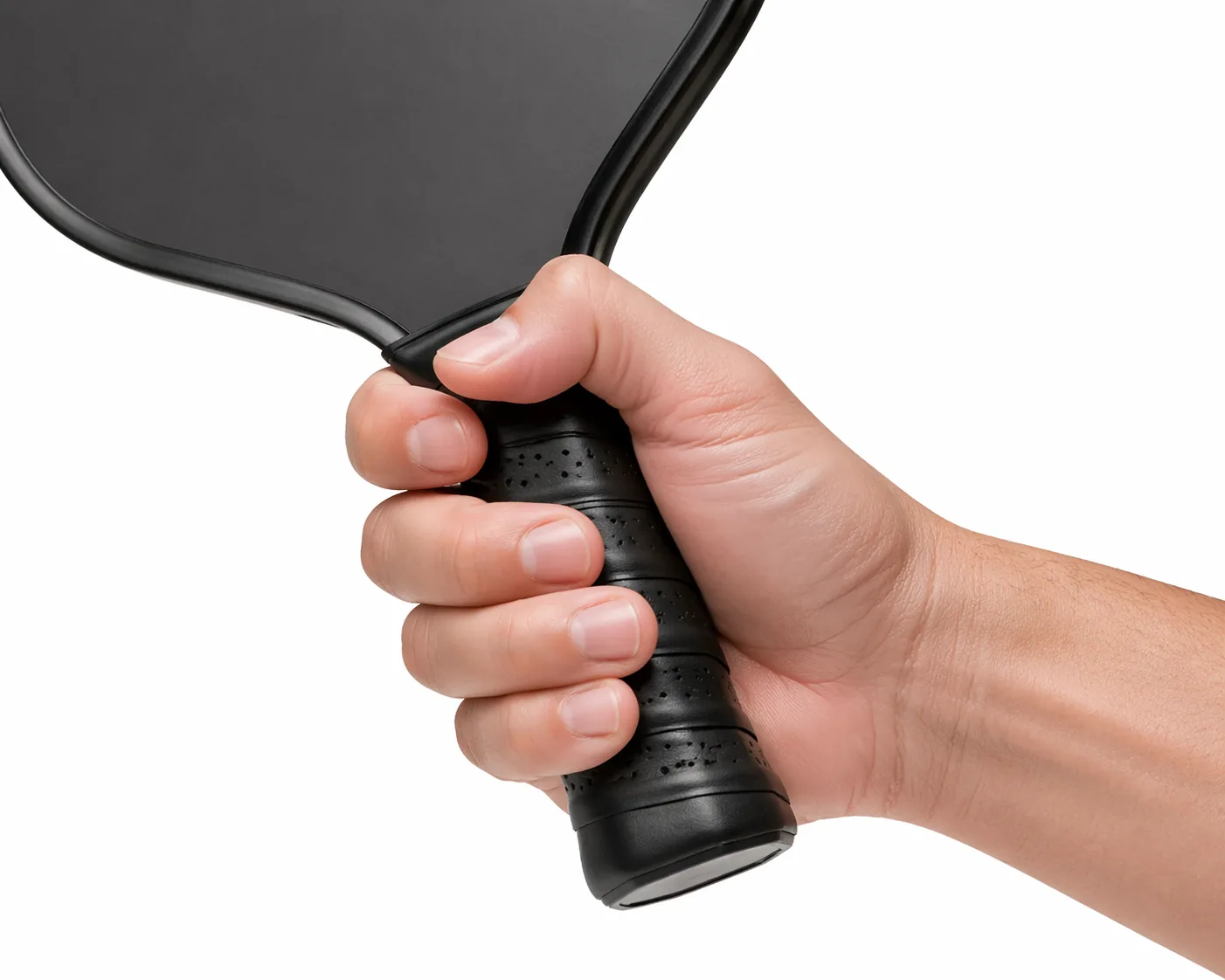
Most players never measure their grip size. They pick up whatever paddle they first tried, get used to it, and call it done. That’s a mistake — grip size affects control, wrist stability, fatigue, and most importantly, elbow injury risk more than almost any other spec on a paddle.
The right grip size is easy to measure, easy to adjust, and almost always worth the five minutes it takes to check.
How to measure grip size
Two methods. Use both — they should agree. If they don’t, the ring-finger method wins.
Method 1: Ring-finger measurement
- Hold your dominant hand palm up, fingers slightly open, relaxed.
- Identify the three horizontal creases across your palm. You want the middle crease — the one that runs roughly through the center of your palm.
- With a ruler, measure from the middle crease straight up to the tip of your ring finger (not index, not middle — ring finger).
- That measurement is your grip size.
Typical results:
- Under 4”: small hands (often juniors, teens, women)
- 4” to 4 1/8”: most common for women and smaller-handed men
- 4 1/4”: most common for average-sized men
- 4 3/8” to 4 1/2”: larger-handed men
Method 2: Index-finger fit check
- Grip the paddle normally, as you would for play.
- With your non-dominant hand, try to slide your index finger between the tips of your fingers and the base of your palm (the fleshy part below the thumb).
Results:
- Index finger fits snugly with slight resistance: correct size.
- Index finger slides in easily with room to spare: grip too small.
- Index finger can’t fit at all: grip too large.
Grip size chart
| Measurement | Grip size | Typical player |
|---|---|---|
| Under 4” | 3 5/8” to 3 7/8” | Juniors, smaller-handed adults |
| 4” to 4 1/8” | 4” | Women, smaller-handed men |
| 4 1/8” to 4 1/4” | 4 1/8” to 4 1/4” | Most adult men |
| 4 1/4” to 4 3/8” | 4 1/4” to 4 3/8” | Larger-handed men |
| Over 4 3/8” | 4 1/2” | Largest hands |
What happens when the grip is wrong
Too small
- Paddle twists in your hand on off-center hits
- Tighter grip tension needed to prevent twisting → forearm fatigue
- Higher elbow injury risk from the chronic tight grip + wrist instability combo
- Pro for some players: more wrist action available for spin shots, but at the cost of all of the above
Too large
- Less wrist mobility — harder to hit spin shots or snap the paddle
- Stiffer forearm from the larger grip circumference stretching the hand
- Slower reaction at the kitchen line — the bigger grip takes longer to maneuver
- Pro for some players: reduces over-wristing, which can stabilize players with whippy technique
The injury angle
Grip too small → clench harder → chronic strain on the extensor tendons at the lateral epicondyle → pickleball elbow.
If you’ve had any tennis-elbow-like symptoms, re-check your grip size. If you’re borderline between two sizes, pick the larger one. It’s the single most effective paddle adjustment for reducing elbow strain.
For more on elbow prevention, see our pickleball elbow prevention guide.
Adjusting grip size after purchase
You can only adjust in one direction: larger. A grip can be wrapped thicker; it cannot be shaved thinner without risking structural damage to the paddle handle.
Overgrip (thin layer, +1/16” to +1/8”)
An overgrip is a thin tape you wrap over the existing grip. Adds 1/16” (one grip size) per overgrip layer. Typically used for:
- Sweat absorption (gets replaced regularly)
- Minor grip size adjustment
- Tackier feel
Brands: Tourna Grip, Wilson Pro Overgrip, Gamma Supreme.
Replacement grip (moderate, +0 to +1/8”)
The primary grip, wrapped directly around the bare handle. Replacing with a different thickness adjusts size moderately. Used when:
- Your current grip is worn out
- You want to change grip feel (cushioned vs. tacky)
- Minor size adjustment
Heat shrink sleeve (major, +1/4” to +1/2”)
A plastic sleeve that heat-fits over the handle, building up the circumference significantly. Used when:
- The paddle is 1–2 sizes too small
- You don’t want to stack multiple overgrips (gets spongy)
Can you reduce grip size?
Technically yes, by sanding down the handle, but:
- Voids the warranty on most paddles
- Risks structural damage to the handle core
- Rarely works well — paddle handles aren’t designed for it
Better approach: buy a smaller grip from the start. If you already own a paddle that’s too large, sell it or keep it as a loaner.
Grip thickness and feel
Separate from size is grip cushioning:
- Thin / tacky grips (Tourna Grip) → more direct paddle feel, less vibration absorption, better for hot hands
- Cushioned grips (Gamma Hi-Tech, Wilson Pro) → softer hand feel, absorbs vibration, comfortable for long sessions
- Tacky synthetic (Wilson Pro Overgrip) → sticky grip even when sweaty
For players with any elbow or wrist pain, cushioned grip compounds reduce vibration transmission into the arm — a noticeable improvement when combined with correct grip size.
Replacing worn grip tape
Grip tape degrades faster than players notice. Signs it’s time to replace:
- Visible fraying or peeling at the edges
- Shiny, smooth spots where the tack has worn off
- You’re gripping harder than you used to without realizing
- Your hand slips, especially in humidity
Replace every 3–6 months with regular play, or sooner if you play in humid conditions.
Cost: $5–$15 for overgrips, $10–$25 for replacement grips. One of the cheapest performance upgrades in pickleball.
Frequently asked questions
- How do I measure my pickleball paddle grip size?
- Hold your dominant hand palm up. Find the middle crease across your palm. Measure straight up from that crease to the tip of your ring finger. That measurement in inches is your grip size. Most adults land between 4" and 4 1/4".
- What's the most common pickleball paddle grip size?
- 4 1/4" is the most common adult size, particularly for men. 4" is the most common size for women and smaller-handed players. Paddles ship with 4" to 4 1/4" grips by default at most major brands.
- Is it better to go slightly larger or smaller on grip size?
- Slightly larger, especially if you have any history of elbow or wrist issues. Too-small grips force you to clench harder, which strains the extensor tendons at the lateral epicondyle and causes pickleball elbow. Too-large grips reduce wrist mobility but don't cause injury.
- Can I add an overgrip to make my grip bigger?
- Yes. Each overgrip adds roughly 1/16" to your grip size. One overgrip typically doesn't change the feel much; two layers noticeably increase size. For larger adjustments (+1/4" or more), use a heat shrink sleeve instead of stacking overgrips.
- Can I make a grip smaller?
- Not practically. Sanding down the handle voids most warranties and risks structural damage. If your grip is too large, your options are: remove the overgrips and see if it fits, try a thinner replacement grip, or sell and buy a paddle with a smaller handle.
- How often should I replace grip tape?
- Every 3–6 months with regular play (2–3 times per week). Replace sooner if you play in humid climates, if the grip feels shiny or slick, or if you notice yourself gripping harder than usual. It's one of the cheapest performance upgrades — $5–$15 for a new overgrip.
Sources and further reading
- Dick’s Sporting Goods: Paddle Buying Guide
- Pickleball Central: Complete Paddle Line Guide
- 101 Pickleball: Grip & Weight Essentials
- Selkirk: How to Choose Your Perfect Paddle
- Related: Pickleball Elbow Prevention · Paddle Weight Guide
Last updated May 1, 2026.
The Signal Brief
One useful dispatch each week.
One sharp take, three things worth reading, and the week's buying signals.