
Pickleball
Pickleball Paddle Weight Guide: Finding Your Ideal (2026)
Paddle weight affects power, control, fatigue, and injury risk. Here's how to pick the right weight for your play style, body, and skill level.
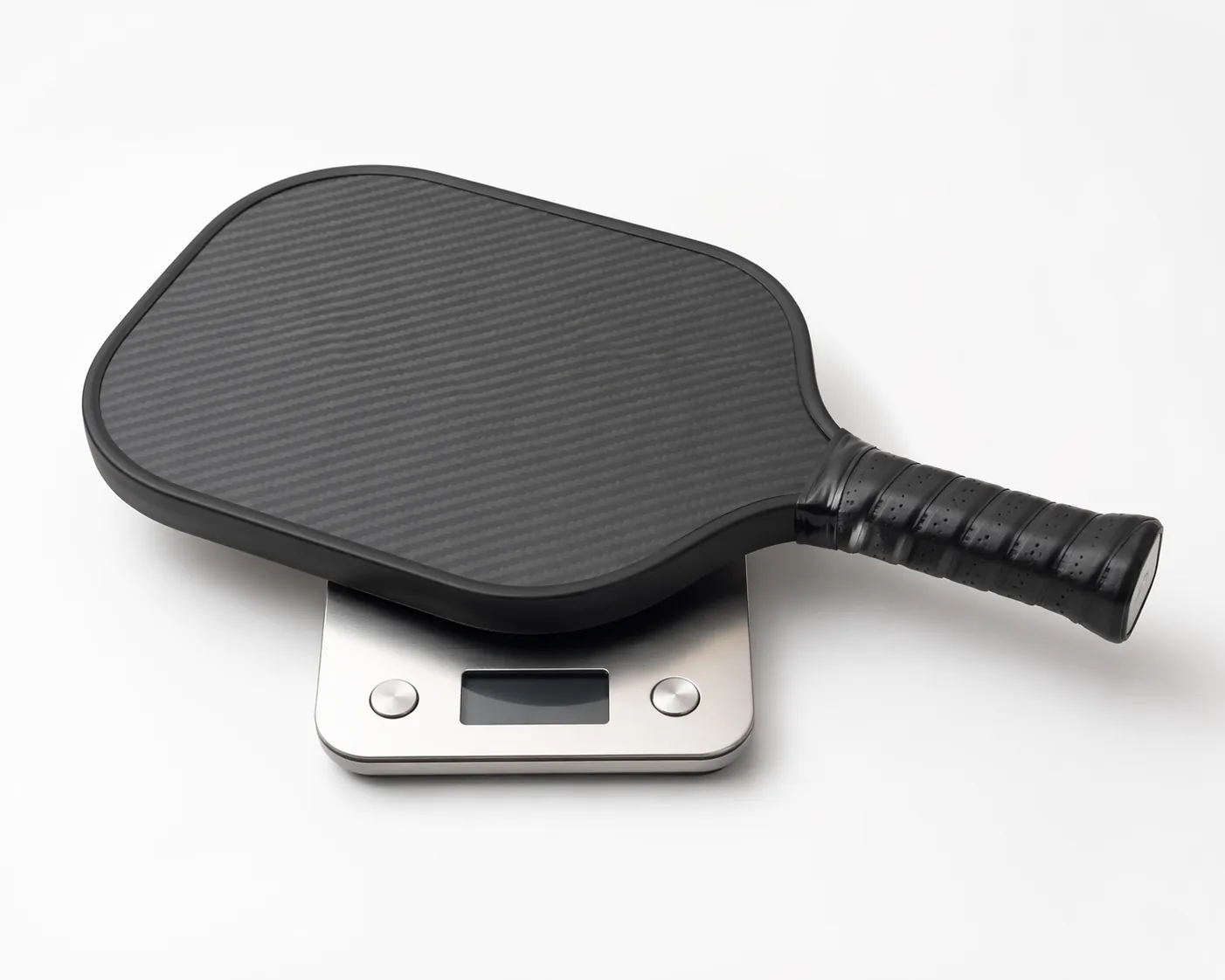
Paddle weight is the single most practical spec to understand — more impactful than face material, core type, or brand. Yet most players pick a weight arbitrarily or default to whatever a friend recommended. This guide walks through how paddle weight actually affects your game and how to choose the right range for your style, body, and skill level.
What paddle weight actually controls
Paddle weight affects four things, in roughly this order:
1. Swing weight (how heavy it feels when you swing)
Swing weight and static weight are related but not identical. Swing weight accounts for where the mass is distributed — a paddle with weight near the head swings heavier than a paddle with the same static weight but mass concentrated near the handle.
For practical purposes, heavier static weight usually means heavier swing weight. Paddles marketed as “head-heavy” have disproportionately high swing weight.
2. Power potential
Heavier paddles transfer more momentum to the ball. Everything else equal, a 8.3 oz paddle hits measurably harder than a 7.3 oz paddle on the same swing.
3. Control and maneuverability
Lighter paddles move faster through the swing path. They’re quicker at the kitchen line, easier to reposition during fast exchanges, and generally give you more margin on reaction shots.
4. Fatigue and injury risk
Heavier paddles fatigue the shoulder, elbow, and forearm faster. Over long rec sessions or tournament days, this compounds into lower shot quality in the last hour. Paddles over 8.3 oz also increase pickleball elbow risk for most recreational players.
The three weight bands
Lightweight: 6.5–7.3 oz
Who it’s for:
- Seniors, especially with any joint concerns
- Players with prior tennis or pickleball elbow
- Small-framed players or those with limited grip strength
- Anyone prioritizing kitchen-line speed
What it costs you:
- Less power on drives
- Less stability on off-center hits
- Harder to swing through heavy spin
Who should avoid this range:
- Competitive 4.0+ players (hard to generate enough pace)
- Larger or stronger players who’d naturally reach for more weight
Example paddles: Selkirk Amped Epic lightweight (~6.8 oz), Gamma Voltage 2.0 (7.5 oz), Selkirk SLK Halo Control (7.3 oz).
Midweight: 7.3–8.3 oz
Who it’s for:
- Most adult recreational players (3.0–4.5 DUPR)
- Players who want a balance of power and control
- Anyone without a specific reason to go lighter or heavier
Typical sub-ranges:
- 7.3–7.8 oz: bias toward control/quickness
- 7.8–8.1 oz: the “default” range, truly balanced
- 8.1–8.3 oz: bias toward power/stability
Example paddles: JOOLA Perseus Pro IV (8.1 oz), Selkirk Vanguard Pro (7.9 oz), Ronbus R1.16 (8.0 oz), Engage Pursuit Pro1 (8.0 oz).
Heavyweight: 8.3–8.6 oz
Who it’s for:
- Competitive 4.5+ players, especially with power-first play styles
- Physically strong players (typically men 180+ lbs)
- Players transitioning from tennis who want more mass
What it costs you:
- Significant shoulder fatigue over long sessions
- Slower reaction time at the kitchen
- Higher pickleball elbow risk
- Harder to produce touch shots (dinks, drops, resets)
Who should avoid this range:
- Anyone under 4.0 DUPR
- Players with any history of shoulder, elbow, or wrist issues
- Players who don’t dedicate time to forearm conditioning
Example paddles: JOOLA Perseus Pro IV Swing Weight (8.3+ oz), Six Zero Double Black Diamond Power (8.3+ oz), custom lead-tape builds.
How to pick the right weight for you
Step through these factors:
Factor 1: Physical limitations
If any of these apply, start lighter (6.5–7.5 oz):
- Prior tennis elbow or pickleball elbow
- Shoulder or rotator cuff injury
- Wrist tendonitis or carpal tunnel
- General grip strength limitations (arthritis, small frame)
- Age 65+
Factor 2: Play style
- Control/touch player: 7.3–7.9 oz
- Balanced all-court: 7.8–8.1 oz
- Power/aggressive: 8.0–8.3 oz
Factor 3: DUPR level
- Under 3.0: 7.3–7.8 oz (prioritize control while learning)
- 3.0–4.0: 7.8–8.1 oz (balanced)
- 4.0–4.5: 7.9–8.3 oz (based on play style)
- 4.5+: any range based on refined preference
Factor 4: Gender, size, strength
Broad generalizations (individual variation matters more):
- Women, smaller-framed: 7.0–7.8 oz
- Average-sized adults: 7.5–8.1 oz
- Larger or stronger adults: 7.9–8.3 oz
Factor 5: Session length
If you play 2+ hour sessions regularly:
- Drop 0.1–0.2 oz from whatever your base recommendation is. Small weight differences compound over long play.
Adjusting paddle weight with lead tape
You don’t have to buy exactly the right weight. Lead tape lets you customize:
What you can do: add weight in specific locations. What you can’t do: remove weight from an existing paddle.
Placement matters
Where you add weight changes the paddle’s behavior:
- 3 and 9 o’clock positions (sides of the paddle face): increases stability on off-center hits, expands effective sweet spot. Most popular modification.
- 12 o’clock (top of paddle): increases power, reduces maneuverability. For power-oriented players.
- Handle base: counterweights a head-heavy paddle, restores quickness.
How much to add
Start with small amounts. 2–4 grams total is a typical modification. Lead tape comes in 0.25 oz (7g) strips that can be cut to size.
Cost
A roll of tungsten or lead tape is $8–$15 and adjusts multiple paddles over years of use.
Static weight vs swing weight vs twist weight
These three numbers describe paddle mass and balance:
- Static weight = total paddle mass on a scale (what most specs list)
- Swing weight = how heavy the paddle feels during a swing (depends on mass distribution, specifically how far mass is from the handle)
- Twist weight = resistance to rotational forces on off-center hits (higher = more stable)
For buying decisions, static weight is what you’ll see on product pages. For fine-tuning, swing weight and twist weight matter more — premium paddle brands publish these numbers in detailed specs.
Common weight mistakes
Mistake 1: “More weight = better play”
Wrong below 4.5 DUPR. Heavier paddles amplify mistakes at lower levels. The control needed to use an 8.3 oz paddle effectively takes years to develop.
Mistake 2: Going too light chasing quickness
Below 7.0 oz for a competitive player, you lose stability and need to swing harder to generate pace — which actually increases fatigue. The 6.5–7.0 oz range should be specifically justified (usually injury).
Mistake 3: Ignoring fatigue signs
Chronic end-of-session shoulder, elbow, or forearm soreness usually means your paddle is too heavy. Drop 0.3–0.5 oz and reassess over 2 weeks.
Mistake 4: Matching a pro’s weight
Pros use weights optimized for their play style, conditioning, and match length. Ben Johns’s paddle doesn’t help you; your paddle helps you.
Frequently asked questions
- What's the best pickleball paddle weight for beginners?
- 7.3–7.8 oz for most beginners. Lighter paddles let you focus on technique without fighting the paddle. Heavier paddles (8.0 oz+) require more strength to wield consistently and amplify technique errors at the beginner level. Start lighter; you can adjust upward as your skills develop.
- Is an 8 oz paddle too heavy?
- 8 oz is right at the upper end of 'midweight' and is fine for most adult players. It's too heavy if you experience shoulder or elbow fatigue during sessions, if you're a senior or have injury concerns, or if you're under 3.0 DUPR and still learning technique. For most 3.0–4.5 players, 8 oz is a reasonable default.
- Can I add weight to a pickleball paddle?
- Yes, with lead tape. You can add weight at the 3/9 o'clock positions for stability, at 12 o'clock for power, or at the handle for counterweighting. Start with 2–4 grams total and adjust based on feel. You cannot remove weight from a paddle — so buy slightly lighter than your target if you plan to tape up.
- Does paddle weight cause tennis elbow?
- Heavier paddles (over 8.3 oz for recreational players) correlate with higher pickleball elbow risk, especially combined with a tight grip and whippy wrist action. Dropping from 8.3 to 7.8 oz is one of the most effective paddle adjustments for reducing elbow strain. See our pickleball elbow prevention guide for full details.
- Do women need lighter paddles?
- On average, yes — most women land in the 7.0–7.8 oz range that balances quickness and stability for their typical grip strength. But individual variation matters more than gender averages. Some women prefer heavier paddles; some men prefer lighter ones. Pick based on your play style and fatigue response, not your gender.
- What's the difference between static weight and swing weight?
- Static weight is the paddle's total mass on a scale. Swing weight is how heavy the paddle feels when you swing it, which depends on where the mass is distributed. A head-heavy paddle has high swing weight for its static weight; a balanced paddle has lower swing weight. Premium paddles publish both numbers; budget paddles typically only list static weight.
Sources and further reading
- Selkirk: How to Choose Your Paddle
- Pickleball Union: Paddle Weight Ideal for Seniors
- Pickleball Central: Paddle Buying Guide
- 101 Pickleball: Grip & Weight Guide
- Related: Paddle Grip Size Guide · Pickleball Elbow Prevention · Best Paddles for Seniors
Last updated May 5, 2026.
The Signal Brief
One useful dispatch each week.
One sharp take, three things worth reading, and the week's buying signals.