
Pickleball
DUPR Rating Chart by Skill Level (2026 Guide)
The 2.000 to 8.000 DUPR scale explained by skill level, with concrete benchmarks for what each rating looks like on the court.
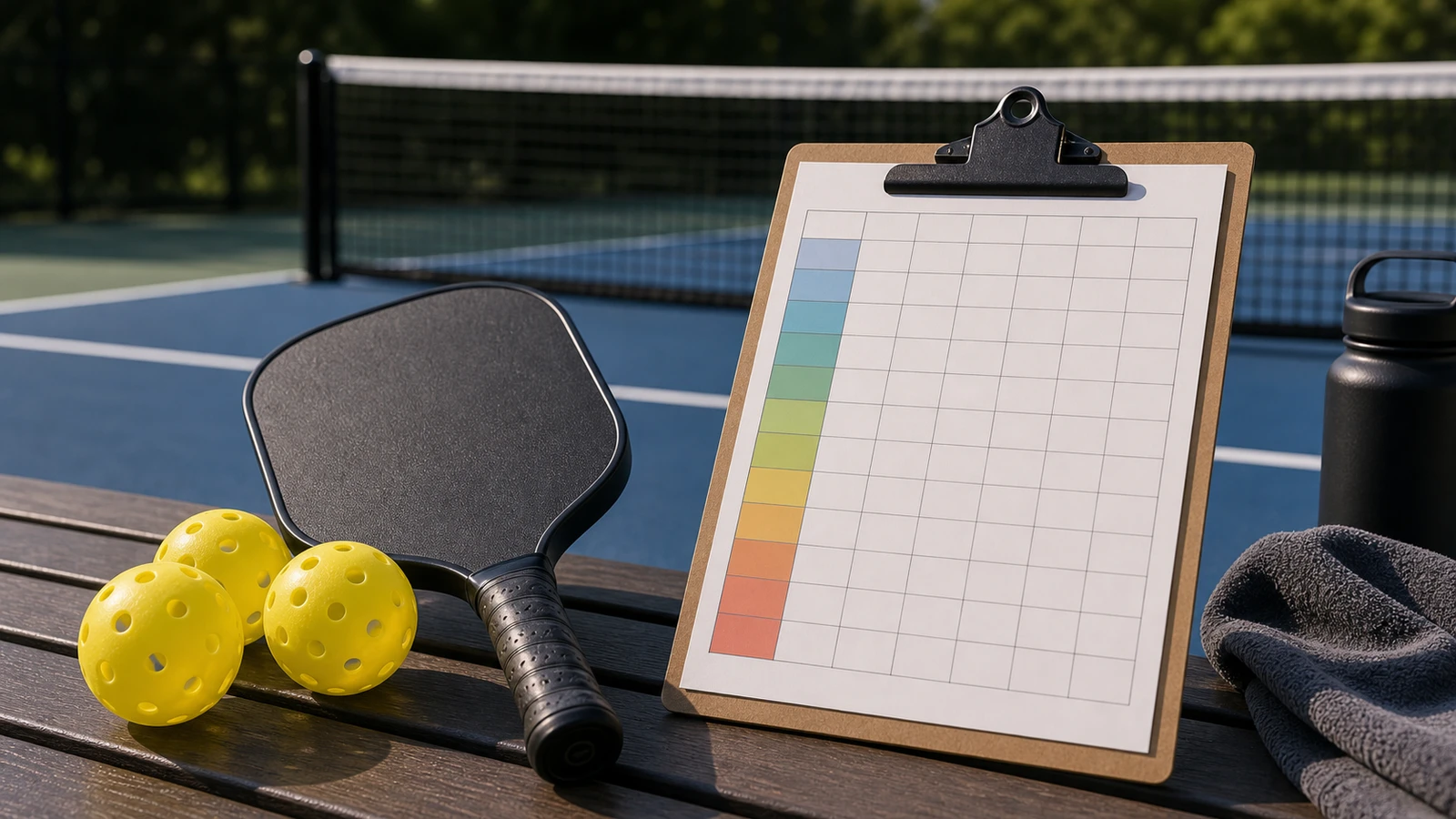
DUPR is the rating system most widely used in US pickleball, and if you’ve played in any sanctioned event in the last two years, you probably have one. But the published documentation mostly explains the math — not what each rating actually looks like in a real game. This article maps the 2.000 to 8.000 scale to observable skill, so you can estimate where you actually sit and what to train next.
How DUPR actually works
DUPR is a dynamic rating system. Before each match, the algorithm predicts an “expected” score based on the combined ratings of both teams. If you perform better than expected, your rating rises; if you perform worse, it drops.
Two things matter for interpretation:
-
Rating is continuous. You can be a 3.52, not just a 3.5. The rounded categories in tournament draws (3.0, 3.5, 4.0) are just bracket labels.
-
One result doesn’t matter much. Your rating stabilizes after roughly 10–20 recorded matches. Below that, individual games shift the number significantly.
Players start as NR (Not Rated) and get their first rating after one recorded result. The rating becomes reasonably stable (moves less than 0.1 per match) around the 20-match mark.
The DUPR chart — what each level looks like
Ratings below are consensus descriptions from US Pickleball, DUPR’s own documentation, and the pickleball coaching community. Skill varies within each band — these are midpoint descriptions.
2.000 – 2.499 — Beginner
What you can do:
- Hit the ball over the net sometimes
- Understand the basic scoring
- Keep the ball in play for 2–3 shots at a time
What you can’t do yet:
- Serve consistently in bounds
- Direct shots to specific targets
- Sustain rallies reliably
Typical time in this band: 1–3 months of casual play.
Focus to progress: consistent underhand or drop serve. Get the ball in play 80%+ of the time.
2.500 – 2.999 — Advanced beginner
What you can do:
- Serve legally and consistently in bounds
- Hit predictable forehand groundstrokes
- Begin to stay at the kitchen line after a serve return
What you can’t do yet:
- Hit consistent dinks (more than 3–4 in a row)
- Hit a third-shot drop that actually lands in the kitchen
- Recognize when to drive vs drop
Typical time in this band: 2–6 months, depending on play frequency.
Focus to progress: dinking. 20 minutes of dedicated dink drilling per week will move you toward 3.0 faster than anything else.
3.000 – 3.499 — Intermediate
What you can do:
- Sustain a dinking rally of 5+ shots
- Attempt third-shot drops (success rate ~30–40%)
- Play in 3.0 rec and tournament brackets
What you can’t do yet:
- Hit consistent third-shot drops under pressure
- Differentiate when to reset vs when to attack
- Handle speed-ups at the net cleanly
Typical time in this band: 4–12 months of regular play.
Focus to progress: the third-shot drop. Getting that success rate from 40% to 70% is the single biggest jump in pickleball, and it determines whether you stay at 3.0 or break into 3.5.
3.500 – 3.999 — Solid intermediate
What you can do:
- Hit third-shot drops reliably (55–70% success)
- Sustain dinking rallies of 10+ shots
- Recognize kitchen-line position as the winning position
- Play doubles strategically, with movement as a unit
What you can’t do yet:
- Handle high-pace play consistently
- Execute advanced shots like ATP (around the post), erne, or intentional speed-ups
- Read opponents’ setup patterns
Typical time in this band: 6–18 months.
Focus to progress: resetting skills. The ability to take a hard shot and neutralize it into a dink is what separates 3.5 from 4.0.
4.000 – 4.499 — Advanced
What you can do:
- Reset consistently under pressure
- Recognize and counter stacking formations
- Play competitive 4.0 tournaments with some wins
- Execute intentional speed-ups and pressure play
What you can’t do yet:
- Reliably win 4.5 tournament brackets
- Read and respond to multi-shot opponent patterns
- Execute advanced shots (ATP, erne, Bert) under pressure
Typical time in this band: 12+ months.
Focus to progress: tactical pattern recognition. At 4.5+, shot selection matters more than shot execution.
4.500 – 4.999 — Highly advanced
What you can do:
- Win 4.0 tournaments consistently
- Win 4.5 brackets with above-average frequency
- Execute advanced shots under pressure
- Coach lower-level players effectively
Typical time in this band: 18+ months. Many competitive recreational players cap out here.
5.000 – 5.499 — Expert / open-level
What you can do:
- Compete at open tournament level
- Teach professionally
- Handle 5.0 pro-ams
This is the top of the recreational-adjacent bracket. A 5.0 DUPR player is competitive in most open-level matches.
5.500 – 6.499 — Professional
Sanctioned pro tournament level. Most tour-level players fall in this range.
6.500 – 8.000 — Top-tier professional
The highest-ranked professional players in the world. The absolute top in April 2026 is in the 6.9–7.0 range.
Common self-rating mistakes
Four mistakes that lead to people overrating themselves:
-
Counting rec play. Open rec sessions against random partners don’t reflect tournament skill. A 3.0 who frequently plays with 2.5s wins a lot but is still 3.0.
-
Confusing consistency with skill. Being able to sustain a rally isn’t the same as dictating one. A 3.0 player sustains rallies; a 3.5 player controls where they go.
-
Ignoring the serve and drop success rate. If your third-shot drops are 30% or less, you’re 3.0 regardless of how well you dink.
-
Playing in only one format. Being a 3.5 doubles player says nothing about your singles DUPR, which tracks separately.
How to get an accurate DUPR
- Play 10+ recorded matches. Your rating doesn’t stabilize below this.
- Mix opponent skill levels. Playing only same-rated or lower opponents gives you an artificially consistent rating without validating your ceiling.
- Record every match (DUPR app, PickleballBrackets, etc.). Unrecorded rec play doesn’t count.
- Use the right format. Your doubles and singles ratings are separate — don’t conflate them.
Frequently asked questions
- What is a good DUPR rating?
- 'Good' is relative. For recreational players, 3.5 is the inflection point — once you cross it, your pickleball is legitimately competent. 4.0 is where most serious rec players aspire. 4.5+ is competitive tournament level. The median DUPR across all recorded US players is somewhere around 3.2–3.4 based on available data.
- How do I get my DUPR rating?
- Sign up at dupr.com or via the DUPR app. Your first rating appears after any sanctioned tournament result gets uploaded, or after you play at a DUPR-partnered club that records rec play. Some clubs offer 'DUPR sessions' specifically designed to build your rating through recorded rec games.
- Why is my DUPR lower than I expect?
- Most commonly: (1) you're rating yourself against the wrong baseline — open play at your club may not reflect tournament skill, (2) you've played too few matches for the rating to stabilize (needs 10–20 matches), or (3) you've been on a losing streak against better opponents and the rating is temporarily depressed. Give it 10 more matches before concluding.
- What's the difference between DUPR and UTR Pickleball?
- Both are dynamic rating systems on similar scales. DUPR is the official rating used by USA Pickleball and all sanctioned events. UTR Pickleball (UTR-P) is the newer competitor. In practice, DUPR has wider adoption and more recorded matches. Your DUPR and UTR-P are not directly comparable numbers; they run on different algorithms.
- How often does my DUPR update?
- Automatically, every time a match result featuring you gets uploaded. Tournament results usually appear within 24–48 hours of the event ending. DUPR-partnered clubs upload rec session results same-day or next-day.
- Can my DUPR go down?
- Yes. If you lose matches to players the algorithm expected you to beat, your rating drops. Losing streaks against higher-rated opponents also drop your rating if the losses are more decisive than predicted. This is working as intended — the rating reflects current form, not peak form.
Sources and further reading
- DUPR Official: How Ratings Are Calculated
- USA Pickleball Player Ratings
- Pickleball Wiki: 2026 DUPR & UTPR Guide
- TeachMe.To: DUPR Beginner’s Guide
- The Pickleball Gang: Honest Skill Levels Chart
- Related: DUPR Estimator tool · Best Paddles for Intermediate 3.5–4.0 Players · 2026 Serve Rule Changes
Last updated April 30, 2026.
The Signal Brief
One useful dispatch each week.
One sharp take, three things worth reading, and the week's buying signals.