
Espresso
Espresso Grind Size Chart: How Fine Should It Be?
A practical grind-size guide for home espresso: shot time, flow, taste, dose, and when to adjust the grinder instead of everything.
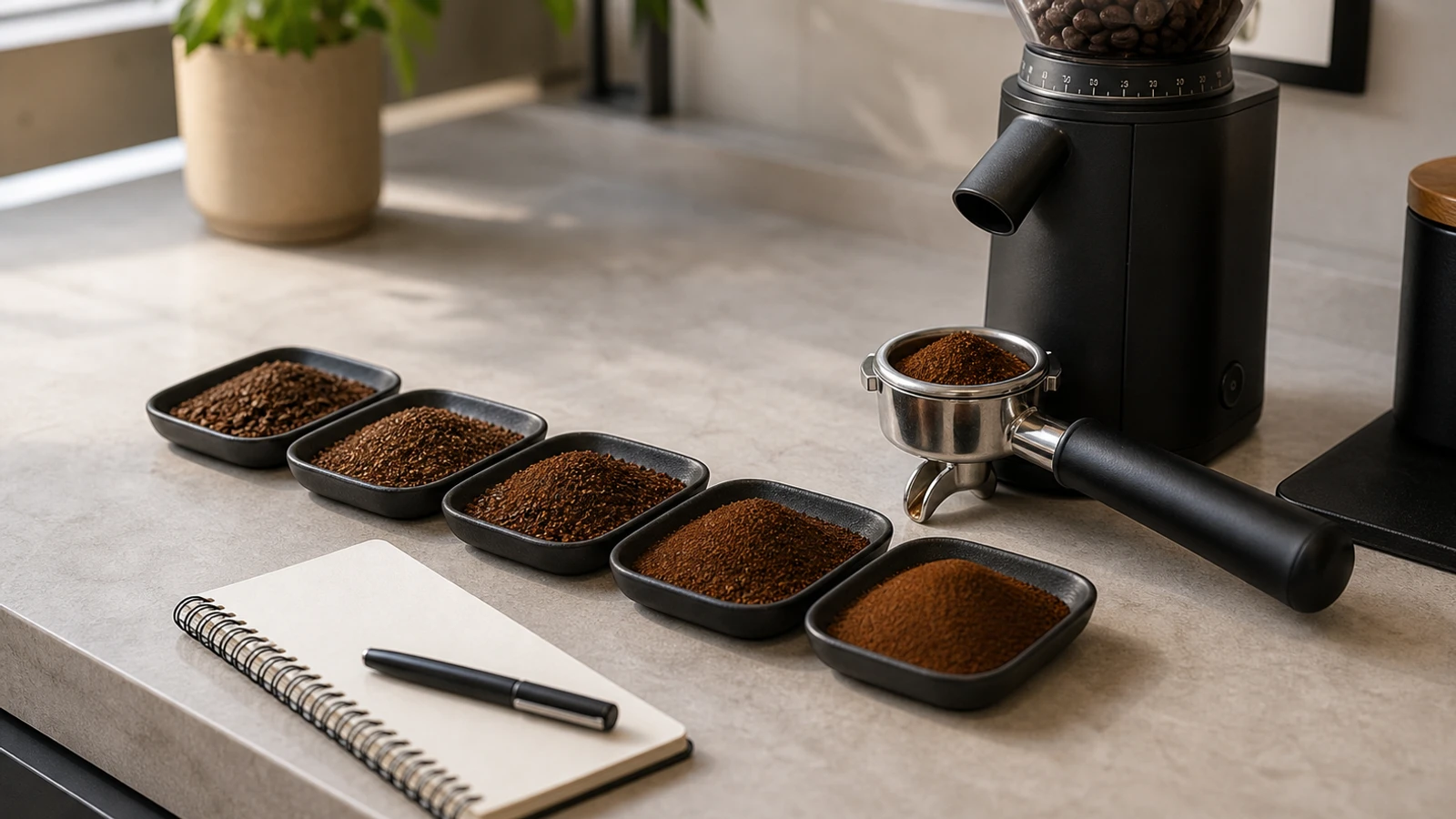
Espresso grind size is not a fixed setting. It changes with the coffee, the grinder, the basket, the dose, and even the age of the beans. That is why “use setting 5” is almost never useful unless two people use the same grinder, the same burrs, and the same coffee.
The better question is: what should the shot do?
Espresso grind size chart
Use this chart as a starting point. It works better than numeric grinder settings because it connects grind to what you can see and taste.
| Shot behavior | Likely grind | Taste | First fix |
|---|---|---|---|
| 36g out in under 20 seconds from 18g in | Too coarse | Sour, thin, sharp | Grind finer |
| 36g out in 25-32 seconds from 18g in | Close | Balanced, sweet, clear | Fine tune by taste |
| Drops slowly, 36g takes 40+ seconds | Too fine | Bitter, dry, heavy | Grind coarser |
| Starts slow, then suddenly gushes | Uneven puck or channeling | Sour and bitter together | Improve prep before changing grind |
| No flow after 10 seconds | Much too fine or overdosed | Harsh, overdone if it runs | Grind coarser or reduce dose |
For most home machines, the common starting recipe is:
- Dose: 18g ground coffee
- Yield: 36g espresso
- Time: 25-32 seconds from pump start
- Ratio: 1:2
This is not a rule. It is a control point. Once you can repeat it, you can make intentional changes.
What “fine enough” looks like
Espresso grounds should look finer than table salt and clump slightly when compressed between your fingers. They should not feel like powdery flour. If the grinder produces visible boulders and dust at the same time, the problem may be grind consistency rather than the setting itself.
The puck should resist water without blocking it. A good shot usually starts with a few dark drops, then develops into a steady stream. If the stream is pale and fast from the beginning, the coffee is usually under-extracted. If the machine struggles and the stream stays drippy for the whole shot, the coffee is usually too fine or packed too tightly.
Adjust grind before changing everything else
When a shot is wrong, beginners often change dose, tamp pressure, basket, temperature, and grind at the same time. That makes the next shot impossible to read.
Use this order:
- Keep the same dose.
- Keep the same yield.
- Keep the same puck prep.
- Change grind by one small step.
- Pull another shot and compare time plus taste.
On a stepped grinder, one click can be a big change. On a stepless grinder, move the dial by a tiny amount and make a note. Espresso is sensitive enough that “a little finer” should actually mean a little.
Dose and grind are linked
If you increase dose without changing grind, the puck gets deeper and harder for water to pass through. The shot slows down. If you reduce dose, the puck gets shallower and the shot speeds up.
That means two changes can cancel each other out:
- Finer grind + lower dose may look similar to the old shot.
- Coarser grind + higher dose may also look similar.
For a beginner, keep dose fixed until the shot is close. After that, adjust dose only if the basket is clearly overfilled or underfilled.
The “one notch finer” trap
Grinding finer can improve sour espresso, but it can also create channeling. If water finds a crack through an overly fine puck, part of the coffee over-extracts while the rest under-extracts. The cup tastes sour and bitter at the same time.
Signs of channeling:
- Espresso sprays sideways from a bottomless portafilter
- Stream starts dark, then turns blond very quickly
- Puck has obvious holes or cracks
- Shot time looks normal but flavor is harsh and hollow
If you see those signs, do not keep grinding finer. Improve distribution, use a level tamp, and make sure the basket is not overfilled.
A practical dialing routine
For a new bag of beans:
- Start at 18g in, 36g out.
- Pull the first shot and record time.
- If it is under 20 seconds, grind finer.
- If it is over 40 seconds, grind coarser.
- When it lands near 25-32 seconds, taste.
- If it is sour, go slightly finer or pull a little longer.
- If it is bitter and dry, go slightly coarser or pull a little shorter.
Do not chase a perfect number. A 24-second shot that tastes sweet is better than a 30-second shot that tastes hollow.
When grind size is not the problem
Grind is the main espresso control, but it is not the only one. If every shot is bad even after careful adjustments, check these:
- Beans too old: espresso usually becomes harder to dial after beans lose aroma and gas.
- Beans too fresh: very fresh beans can be foamy and unstable.
- Water temperature: sour shots can come from water that is too cool.
- Basket mismatch: some baskets need a narrower dose range.
- Pressurized basket: grind changes are less direct with pressurized baskets.
- Dirty machine: old coffee oils can make good shots taste bitter.
Sources and further reading
- Specialty Coffee Association coffee standards
- Barista Hustle Espresso Compass
- La Marzocco Home FAQ on maintenance and water
Frequently asked questions
- What grind setting should I use for espresso?
- There is no universal number. Start fine enough to pull roughly a 1:2 ratio in 25-32 seconds, then adjust by taste. Grinder numbers are only meaningful for that specific grinder and coffee.
- Should I grind finer if espresso tastes sour?
- Usually, yes. Sour and fast shots are often under-extracted. Grind finer first, but stop if the puck starts channeling or the shot becomes sour and bitter at the same time.
- Can espresso be too fine?
- Yes. If the machine chokes, the shot drips for 40+ seconds, or the cup tastes dry and bitter, the grind is probably too fine for that dose and basket.
Last updated May 7, 2026. See our editorial policy for methodology and corrections.
The Signal Brief
One useful dispatch each week.
One sharp take, three things worth reading, and the week's buying signals.