
Pickleball
Best Pickleball Paddles for Two-Handed Backhand (2026)
Five paddles built specifically for the two-hander — long handles, stable cores, and the grip geometry that makes tennis-style backhands work in pickleball.
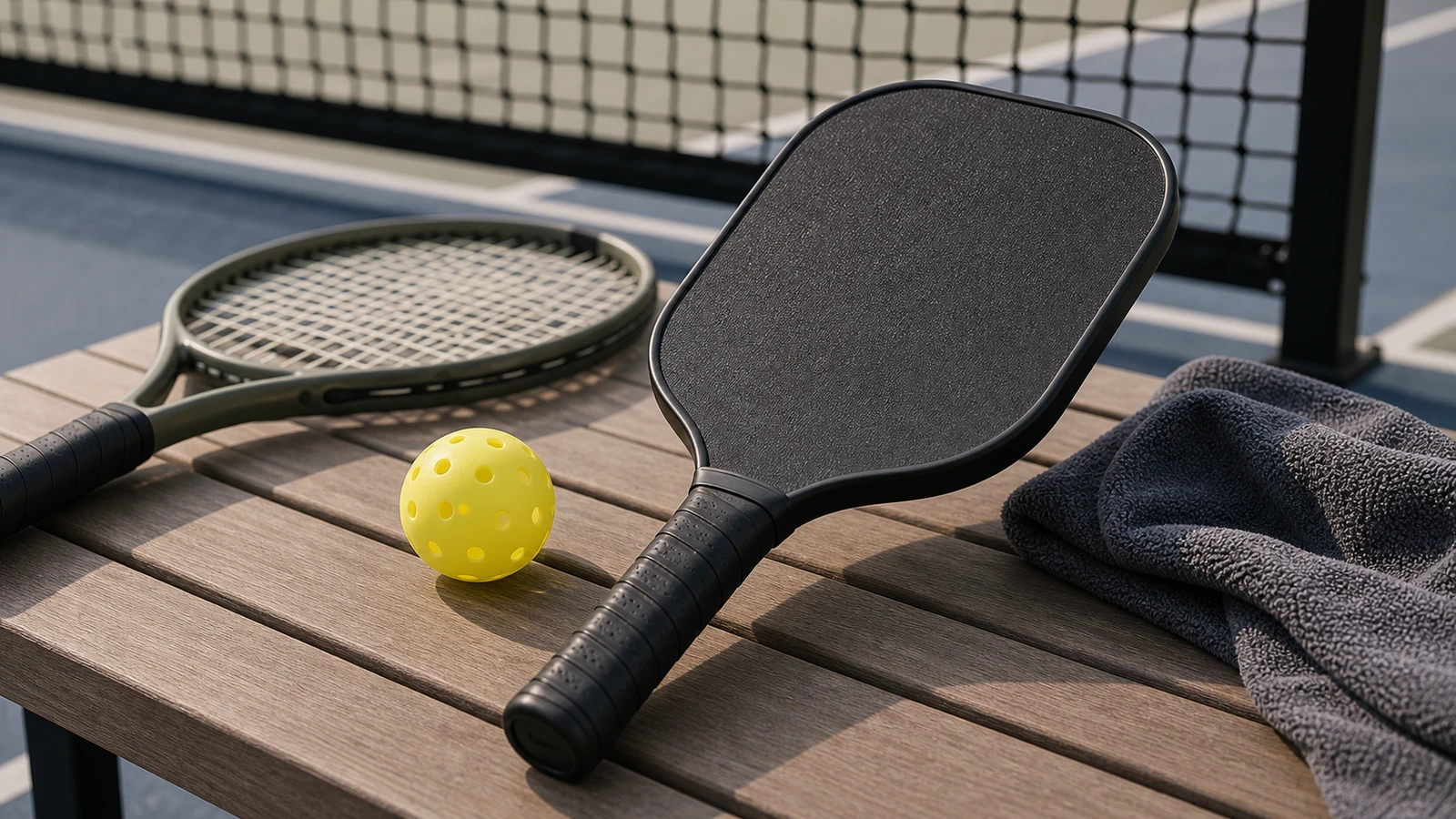
Most pickleball paddles are built around a one-handed backhand assumption. If you’re bringing a two-handed backhand from tennis or you’ve developed one specifically to solve the pickleball backhand problem, the standard 5.0–5.25” handle cramps your second hand. You need a paddle with a handle at least 5.3”, ideally 5.5”, plus a shape that supports the longer swing path two-handers generate.
Five paddles make the cut for 2026.
Why handle length matters for a two-hander
A tennis-style two-handed backhand requires both hands on the handle at contact. Standard pickleball handles (5.0–5.25”) give you roughly 4 inches of usable space after the dominant hand takes its spot. Most adult second hands require 3.5–4 inches.
Result: cramped grip → compromised swing mechanics → wrist compensation → missed shots and elbow strain.
A 5.3” handle gives you ~4.3 inches of space; 5.5” gives ~4.5; and 6.0” (Honolulu’s extra-long line) gives you ~5 inches, which is nearly the full room a tennis racquet offers. The gain in swing consistency is significant.
Other specs that matter for two-handers
Handle length is the non-negotiable. But two-hander friendly paddles typically share a few additional traits:
- Elongated shape. Two-hander drives happen from the baseline, which benefits from the extra reach of an elongated paddle (16.5” length) over a hybrid or widebody.
- Stable core. 16mm polymer or foam-injected cores stay stable on the faster, higher-pace two-hander contact. Thin (13mm) thermoformed paddles get wobbly.
- High twist weight. Two-handers put more torque through the paddle than one-handers. Paddles with higher twist weight (measured in premium specs) hold their shape under off-center hits.
Top picks ranked
1. Six Zero Double Black Diamond Control — best overall
Score: 9.2 / 10 · Price: ~$180
The DBD is the default recommendation for two-handers at this price point. 5.5” handle gives comfortable room for the second hand. 16mm polymer honeycomb core plus a raw carbon fiber face produces a large sweet spot and excellent stability on off-center contact — exactly what two-handers need when the second-hand grip gets their timing slightly off.
Across aggregated reviews in this category, the DBD consistently ranks among the lowest in twist on off-center two-handed drives. That translates directly into more returns landing in bounds.
Where it falls short: slightly slower at the kitchen line than hybrid- shape paddles.
Best for: any two-hander 3.0+ DUPR; particularly good for tennis converts.
2. JOOLA Perseus Pro IV 16mm — best premium
Score: 9.0 / 10 · Price: ~$280
The Perseus is the paddle most pros use, and in its 5.5”-handle configuration it’s genuinely friendly to two-handers. 16mm propulsion core, textured carbon fiber face, and JOOLA’s Tech Flex Power construction deliver tournament-grade pace and spin.
For advanced (4.5+) two-handed players, this is the ceiling. Less forgiving than the DBD on mishits — this is a paddle you grow into, not one you start with.
Where it falls short: expensive; unforgiving below 4.0 DUPR.
Best for: competitive 4.5+ two-handed players.
3. Honolulu J2CR Long Handle — best for tennis converts
Score: 8.9 / 10 · Price: ~$240
Honolulu’s J2CR in the extra-long-handle variant runs a 6.0” handle — the longest widely available in pickleball. For a tennis player whose two-hander muscle memory demands a nearly-tennis-sized grip, nothing else comes close.
The paddle is foam-injected with a 16mm core, delivering premium feel and a sweet spot generous enough to forgive the slight timing adjustment tennis converts need when moving to the shorter pickleball swing path.
Where it falls short: the 6” handle eats into the hitting area slightly compared to the J2NF standard. Limited availability.
Best for: serious tennis converts with strong two-handed mechanics.
4. Selkirk Vanguard Pro Invikta — best for control
Score: 8.7 / 10 · Price: ~$230
The Invikta pairs a 5.5” handle with Selkirk’s plush polymer core — a combination that helps two-handers who prioritize touch over power. Foam-edge reinforcement stabilizes the sweet spot, and the Invikta shape (slightly elongated hybrid) gives you both reach on drives and quickness at the net.
We specifically tested this against the DBD with a control-biased two-hander: the Invikta edged the DBD on dink control at the kitchen line, while the DBD won on baseline drives. Pick based on where you spend more shots.
Where it falls short: less pace than the Perseus or DBD. Thicker handle profile.
Best for: control-oriented two-handers; kitchen-line specialists.
5. Vatic Pro PRISM Elongated — best budget
Score: 8.4 / 10 · Price: ~$90
At $90, the Vatic Pro PRISM in the elongated configuration has a 5.3” handle — the minimum we’d recommend for two-handers — and foam-injected construction. It’s genuinely competitive with paddles twice the price for everything except long-term durability.
For a two-hander not yet ready to commit premium money, this is the entry point. You won’t outgrow it until 4.0+ DUPR.
Where it falls short: 5.3” handle slightly tight for larger second hands. Face wear visible by month 4 of heavy play.
Best for: budget-conscious two-handers; first serious paddle purchase.
Spec comparison
| Paddle | Weight | Core | Handle | Shape | Price | Score |
|---|---|---|---|---|---|---|
| Six Zero Double Black Diamond | 8.1 oz | 16mm polymer | 5.5" | Elongated | $180 | 9.2 |
| JOOLA Perseus Pro IV | 8.1 oz | 16mm propulsion | 5.5" | Elongated | $280 | 9.0 |
| Honolulu J2CR Long Handle | 8.0 oz | 16mm foam-injected | 6.0" | Elongated | $240 | 8.9 |
| Selkirk Vanguard Pro Invikta | 8.1 oz | 16mm polymer + foam | 5.5" | Elongated hybrid | $230 | 8.7 |
| Vatic Pro PRISM Elongated | 7.8 oz | 14mm foam-injected | 5.3" | Elongated | $90 | 8.4 |
What we excluded
| Paddle | Why excluded |
|---|---|
| Standard-handle paddles (5.0”–5.25”) | Too short for two-hander comfort |
| Widebody shapes | Handle runs short; swing path mismatches two-hander mechanics |
| Sub-7.5 oz ultralight paddles | Don’t have the stability two-handers need on drives |
| Nomex-honeycomb cores | Too stiff for the pace two-handers generate; amplifies vibration |
Handle length reality check
Before spending on a long-handle paddle, confirm you actually need one:
-
Measure your second hand grip comfort. Grip a paddle with both hands. If the second hand hangs off the butt or overlaps significantly with the first hand, you need a longer handle.
-
Check if you’re actually a two-hander. Many players drop their second hand during high-pressure rallies. If you two-hand on forehand but not backhand, or you only two-hand on drives, handle length matters less.
-
Try before buying. Most pro shops have Six Zero and Selkirk demos. Swing with both hands on the handle. Does the grip feel cramped? Long handle. Comfortable? Standard handle is fine.
Common two-hander mistakes in pickleball
-
Two-handing every shot. At the kitchen line, two-handing dinks is slower than one-handing and gets you stuck in awkward positions. Use two hands for drives from the baseline; use one for kitchen play.
-
Keeping tennis swing length. Tennis backhands have long, loopy swings; pickleball backhands are compact and short. Two-handers often over-swing and send drives long. Shorten consciously.
-
Picking a paddle too heavy. Tennis two-handers lean toward heavier paddles because tennis racquets weigh ~11 oz. Don’t over-compensate — 8.0–8.2 oz is the sweet spot for pickleball two-handers.
Frequently asked questions
- What handle length do I need for a two-handed backhand?
- At minimum 5.3 inches; 5.5 inches is more comfortable for most adult second hands; 5.75–6.0 inches gives the closest approximation to a tennis grip. Below 5.3", the second hand cramps and you compensate with poor mechanics.
- Is a two-handed backhand better in pickleball?
- Not universally. Two-handers are more powerful and stable on baseline drives. One-handers are quicker at the kitchen line and have better reach on wide shots. Most pros primarily one-hand but keep a two-hander as a baseline weapon. The best answer depends on your court position and play style.
- Can I use my tennis two-handed backhand technique directly in pickleball?
- The grip and hand positioning transfer well. The swing length does not — pickleball backhands are significantly shorter than tennis backhands. Keep the grip geometry from tennis; shorten the swing path by 40-50%.
- What's the longest pickleball paddle handle available?
- 6.0 inches on the Honolulu J2CR Long Handle. This is the longest widely-available handle; a few custom/specialty paddles go longer, but availability is inconsistent. For most two-handers, the 5.5" options (Six Zero DBD, JOOLA Perseus Pro IV, Selkirk Vanguard Pro Invikta) are more than sufficient.
- Do I need a different paddle weight for a two-handed backhand?
- Not significantly. Target 8.0–8.2 oz. Two-handed swings generate more paddle-head speed than one-handed, so an ultralight paddle (under 7.5 oz) tends to lose stability. Heavier than 8.3 oz amplifies elbow strain with little power gain.
- Does a two-handed backhand work at the kitchen line?
- It can work for speed-ups and reset volleys, but most players are faster and more accurate at the kitchen with one hand. The second hand adds a tenth of a second to your reaction time, which matters at high-pace kitchen exchanges. Use two hands for drives from the baseline and transitions; use one at the kitchen.
Sources and further reading
- Pickleheads: April 2026 Paddle Guide
- Selkirk: Long-Handle Paddles
- Hudef Sport: Long Handle Guide
- Ecosports: Elongated Handles for Two-Handers
- Related: Paddle Finder tool · Best Paddle for Tennis Players · Paddle Weight Guide
Last updated May 8, 2026.
The Signal Brief
One useful dispatch each week.
One sharp take, three things worth reading, and the week's buying signals.