
Smart Home
Matter vs Thread vs Zigbee: Smart Home Protocol Guide
Matter, Thread, Zigbee, Wi-Fi, and Z-Wave explained in plain English: what each one does, when you need a hub, and what to buy first.
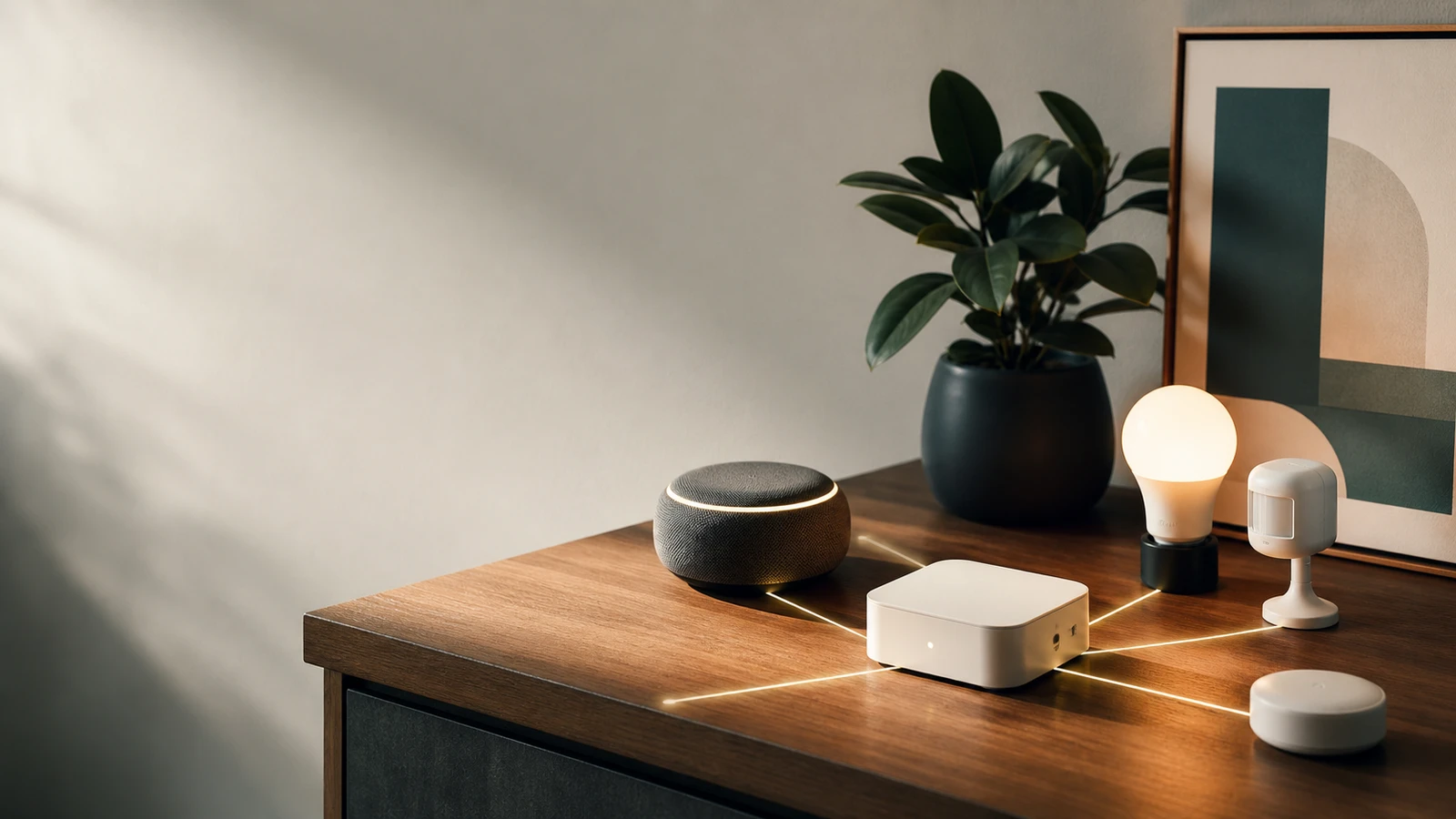
Smart home protocol names are confusing because they do not all describe the same layer. Matter is not the same kind of thing as Thread. Thread is not the same kind of thing as Zigbee. Wi-Fi is not automatically worse. Z-Wave is not dead just because Matter exists.
The practical question is simpler: what should you buy so the device still works after setup day?
The plain-English difference
| Term | What it mainly does | Typical role |
|---|---|---|
| Matter | Common smart home application standard | Lets supported devices work across major ecosystems |
| Thread | Low-power IP mesh network | Carries Matter for sensors, buttons, locks, bulbs, and small devices |
| Wi-Fi | High-bandwidth home network | Carries Matter or vendor apps for plugs, cameras, speakers, appliances |
| Zigbee | Mature low-power mesh stack | Works through hubs such as Hue, SmartThings, or other Zigbee controllers |
| Z-Wave | Sub-GHz smart home mesh protocol | Often used for sensors, switches, locks, and hub-based setups |
Matter is the language. Thread, Wi-Fi, and Ethernet are ways that language can travel. Zigbee and Z-Wave are older but still useful smart home ecosystems that usually need their own hub or bridge.
Choose Matter when compatibility is the problem
Matter exists to reduce ecosystem lock-in. A supported Matter device can be added to compatible platforms without relying only on one vendor app.
That does not mean every feature is identical everywhere. A device may expose basic on/off control through Matter while keeping advanced effects, camera features, or energy dashboards inside the manufacturer’s app. Matter has also expanded over time. As of May 2026, Matter 1.5 and 1.5.1 have added or refined larger categories such as cameras, closures, and energy-management features, but actual product support still depends on certification and platform updates.
Buy Matter when:
- You use more than one ecosystem, such as Apple Home, Google Home, Alexa, or SmartThings.
- You want basic device control to survive even if you change phones or voice assistants.
- The product page clearly says which Matter features are supported.
Do not buy Matter only for the logo. Read the requirements: controller, network, app, hub, Thread border router, and feature list.
Choose Thread for small battery devices
Thread is a low-power, IP-based mesh network. It is designed for devices that need quick local response without joining your regular Wi-Fi as another full-power client.
Thread is usually a good fit for:
- Contact sensors.
- Motion sensors.
- Buttons.
- Some locks.
- Some bulbs, plugs, and small controllers.
Thread devices need a Thread border router somewhere in the home. That border router may be built into a smart speaker, smart display, Wi-Fi router, hub, or other always-powered device. Without the right border router and platform support, a Thread device can be technically good but annoying to set up.
Choose Wi-Fi when the device needs bandwidth
Wi-Fi is still the right choice for many smart home devices. Cameras, video doorbells, speakers, displays, and appliances often need more bandwidth than Thread or Zigbee are meant to provide.
Wi-Fi can also be fine for plugs and bulbs when the home only has a few devices. The downside appears when every cheap bulb, plug, and sensor joins the main Wi-Fi network. That can make troubleshooting harder, especially on older routers or crowded 2.4 GHz networks.
Use Wi-Fi when:
- The device moves video, audio, or large updates.
- You only need a small number of connected devices.
- Your router and guest/IoT network are already set up cleanly.
If the device is a simple sensor or button, Thread, Zigbee, or Z-Wave usually makes more sense.
Keep Zigbee if the ecosystem already works
Zigbee is a mature low-power mesh solution with a large installed base. Many popular lighting, sensor, and hub ecosystems use it. It is not automatically obsolete just because newer Matter and Thread products exist.
Zigbee makes sense when:
- You already use a stable Zigbee hub.
- You want affordable bulbs, sensors, and buttons.
- The device line has a long track record.
- The bridge exposes devices cleanly to your main smart home platform.
The main trade-off is hub dependence. A great Zigbee setup can be very stable, but the bridge is the center of the system.
Use Z-Wave for hub-based reliability
Z-Wave is also a mature smart home protocol, commonly used for sensors, switches, locks, and other control devices. Its sub-GHz radio approach can avoid some 2.4 GHz Wi-Fi congestion, although regional frequency differences and hub compatibility matter.
Z-Wave makes sense when:
- You already have a Z-Wave hub.
- You want wall switches, sensors, or locks in a hub-based setup.
- You value a mature interoperability program.
- Your home has many low-bandwidth control devices.
It is less useful if you want to avoid hubs entirely.
Buying path for a new setup
- Pick the main controller first. Apple Home, Google Home, Alexa, SmartThings, Home Assistant, and other platforms have different strengths.
- Check whether you already own a Thread border router. If not, Thread devices may require another purchase.
- Use Matter when the feature list is clear. Compatibility is useful only when the device exposes the controls you actually need.
- Do not replace working hubs just to be newer. Zigbee and Z-Wave systems can still be the more stable answer.
- Buy one device first. Test setup, response time, family use, and app behavior before replacing a room.
The mistake to avoid
Do not build the smart home around a protocol name. Build it around jobs:
- “Control these ceiling lights from a wall switch.”
- “Know whether a door is open.”
- “Turn lamps on at sunset.”
- “Avoid cloud-only cameras in private rooms.”
Once the job is clear, the protocol choice is easier.
Sources and further reading
- CSA: Matter 1.5 update
- CSA: Matter 1.5.1 update
- Thread Group: Thread in homes
- CSA: Zigbee solution overview
- Z-Wave Alliance: technology overview
- Related: Smart Bulb vs Smart Switch and Router Security Checklist
Frequently asked questions
- Is Matter better than Zigbee?
- Matter is better for cross-platform compatibility when the exact device category and feature are supported. Zigbee can still be excellent when you already have a reliable hub and compatible devices.
- Do Thread devices need Wi-Fi?
- Thread devices do not join Wi-Fi directly, but they usually need a Thread border router that connects the Thread network to the rest of your home network and smart home platform.
- Should I avoid Wi-Fi smart home devices?
- No. Wi-Fi is appropriate for cameras, speakers, displays, appliances, and some plugs. For many small battery sensors, Thread, Zigbee, or Z-Wave is usually cleaner.
Last updated May 12, 2026. See our editorial policy for methodology and corrections.
The Signal Brief
One useful dispatch each week.
One sharp take, three things worth reading, and the week's buying signals.